I’m pleased to announce that I’ve joined Levy Realty Advisors as Senior Vice President of Brokerage and Tenant Representation. It’s basically an extension and expansion on what I’ve been doing for the past 30+ years in South Florida; creating value for owners and occupiers of commercial property in Miami-Dade, Broward and Palm Beach County.
I continue to work through online sources and my own relationships, but I see tremendous opportunity in aligning with Levy Realty Advisors. I’ve known Alan Levy for over 20 years and he has steadily built a great organization and a portfolio of over 3 million square feet of office, industrial and retail space owned and or managed.
Alan recognized that there was a large pipeline of untapped business in finding additional locations for companies in his portfolio, and finding space for companies he couldn’t accommodate. In addition, we expect that by working with owners of properties across the market, we will uncover new investment opportunities to spread our footprint in the South Florida commercial real estate market.
And don’t worry, I’ll still be publishing KensTrends to inform, entertain and continue to generate new business. Read more at www.SFOBA.com
“I am excited and pleased to announce that after many years of knowing Ken Silberling, he will join our company to head up the Brokerage and Tenant Representation division,” said Alan Levy, Broker/President of LRA. “Ken comes to the company with over 30 years of industry knowledge and experience and is well respected amongst his peers in the South Florida Commercial and Industrial market. Ken will be handling brokerage and tenant representation opportunities that we have been passing up for many years due to our focus on our own portfolio of properties.”
“We feel very fortunate to have Ken represent our company,” added Josh Levy, LRA COO. “This is a new chapter in the evolution of our company. Ken’s extensive experience and exposure in the market will help us to continue to expand our footprint throughout South Florida. He will also bring an extended level of service to our tenant base of over 1,000 companies occupying over 3 million square feet of space.”
Posted inIndustrial, Office|Comments Off on New Logo, New Digs, New Deals, New Opportunities
The new Lockhart Stadium from the elevator of Levy Realty Advisors’ Headquarters – Spectrum Office Park, Fort Lauderdale 11-18-2019
Major League Soccer is coming to South Florida much sooner than you think. And it is the centerpiece of one of the largest real estate deals ever proposed for South Florida. From the elevator of Levy Realty Advisors’ headquarters in Fort Lauderdale’s Spectrum Office Park, I can see a new $60 million soccer stadium take shape. The site of the recently demolished Lockhart Stadium and Fort Lauderdale Baseball Stadium will be the temporary home for Inter Miami CF. The new Major League Soccer (MLS) franchise will open their inaugural season here on March 14, 2020. Meanwhile, negotiations continue on the voter-approved 131-acre Miami Freedom Park; a $1 billion stadium, mall, hotel, technology hub and park proposed for the site of the Melreese Golf Course near Miami Airport. This would be the permanent home for the team starting in 2022. So the $1 billion question is:
Can pro soccer be successful in South Florida? As a long-time South Florida sports fan, I was extremely skeptical. This may make you change your mind:
Corner End Zone Nosebleed Seats in Section 300 for the 11/10/19 MLS Championship were selling for $345 on Stub Hub.
My son was in town from Seattle, where he has attended some Seattle Sounders MLS games and enjoyed the experience. We watched on ESPN as Seattle beat Los Angeles FC and earned a spot in the MLS Cup Championship. He thought it would be fun to attend the game and we went online to check on tickets. We found out that the Sounders sold out 70,000 seats in 20 minutes and the worst seats in the stadium were selling for $345 on StubHub. He decided to watch the game on TV and the Sounders wound up winning the championship in front of a raucous record crowd.
A Record MLS Crowd of over 72,000 Packs Atlanta’s Mercedes Benz Stadium
Soccer has definitely caught on in Seattle with an average attendance of over 40,000 per game. In Atlanta, in the football-crazed South, their MLS expansion team posted a winning record in its 2017 inaugural season. Atlanta United now leads the league in attendance at over 53,000. In addition, the culture is changing. Organized youth soccer was very rare when I was growing up in Miami. But my millennial kids and their friends all played soccer and you can’t drive by a field these days without seeing a game going on.
Pele, Soccer’s Greatest of All Time, Leaps Celebrating a Goal vs. Strikers in Front of 77,000 fans in New York, 1977.
For professional soccer in South Florida it has been a rocky road. The Miami Toros started play in the North America Soccer League (NASL) in 1972 and became the Fort Lauderdale Strikers in 1977. I recall sitting in a loud and packed 15,000 seat Lockhart Stadium in the late 1970s as the Strikers posted the league’s best record. The Strikers and the NASL reached their peak in 1977 when Pelé and the New York Cosmos defeated the Strikers in the playoffs in front of 77,000 fans. But attendance began to fade, the Strikers relocated to Minnesota and the NASL folded in 1984. Major League Soccer (MLS) was formed in 1988 as a condition (quid pro quo?) for the US to host the 1994 World Cup. South Florida’s potential as a pro soccer market is illustrated by a 2014 exhibition between the national teams of Brazil and Columbia which drew over 73,000 fans.
Another “friendly” between Brazil and Columbia draws 65,000 to Miami’s Hard Rock Stadium, September 6, 2019.
In 2014, a new group headed by Brazilian superstar Ronaldo purchased a new Strikers franchise hoping to elevate them to their past glory. I negotiated a lease with the team to lease 1,512 square feet for their corporate headquarters minutes from the old Lockhart Stadium. But interest in the re-formed minor league NASL was limited and the deteriorating stadium proved to be a disaster. The team moved to Lauderhill and folded in 2017. At the same time, however, David Beckham began searching for a South Florida home for a new MLS franchise.
So the question is, can soccer survive and even thrive in South Florida? South Florida has always supported a winner as shown by the success of the Miami Heat and until recently, the Dolphins. The financial success of the new team will be closely linked to the success of the team on the field. But can we field a competitive team?
Rendering of the $60 million new Lockhart Stadium, scheduled for completion in time for Inter Miami CF’s opening game in March 2020.
Atlanta United has proven that you can quickly put a winning MLS soccer team on the field and develop a fan base. Beckham can draw from a worldwide talent pool and Miami’s multicultural community and abundant sunshine should prove attractive to players. I believe the key lies in the organization. The Dolphins have always been king in this market. Despite some recent down years, they have consistently been one of the best managed and most successful franchises in the NFL. The Miami Heat took the court in 1988. Mickey Arison has put together an organization and a culture that breeds success and has the championship banners and attendance to prove it. Meanwhile, the Miami Marlins have two championships, but poor management decisions have led to losing teams and anemic attendance. I personally enjoy Marlins Park and think it’s a great facility, but the team’s former owners walked away with all the profits and left Miami taxpayers holding the bag.
Plans for the $1 Billion Miami Freedom Park
David Beckham and his group have billion dollar plans to bring big time soccer to South Florida. And local entrepreneur and co-owner Jorge Mas plans to finance Miami Freedom Park at no cost to taxpayers. Regardless of what happens with Melreese, which has some environmental issues to overcome, Inter Miami CF will take the field in March in Fort Lauderdale. If the Miami deal falls through, Fort Lauderdale could still become the permanent home. Interest in soccer across the US in on the rise. MLS has a contract with ESPN and the English Premier League is televised nationally on NBC. A recent Gallup Poll shows soccer as the second most popular sport behind football among the 18-34 demographic in the US. The attendance for the Colombia – Brazil matches also shows the potential for soccer in our market. I don’t know if Inter Miami seats will be selling for $345 on StubHub any time soon, but MLS appears to be thriving. Personally, I’m a baseball and football guy. But if Beckham and Mas can put together a winning organization which fields a winning team, pro soccer in South Florida will finally be a success.
This is an update on one of my personal favorites that I wrote back in 2011. It is still as relevant today than it was back then. At that time, Florida Commercial Information Exchange (FCIE), emerged as one of the upstart companies that dared to challenge Costar/Loopnet as the dominant provider of commercial real estate information. FCIE was later acquired by Xcelligent which became one of our industry’s all-time epic fails – more on that below.
In the midst of this rewrite, I was contacted by my regional rep for CREXI, which 9 years later, is the latest challenger attempting to knock CoStar off its perch. About a year ago I spoke on a Commercial Real Estate tech panel with CREXI’s national sales director and I knew they just got a new round of funding, so I was very interested. Can they do it? Well, they are trying, they have some good ideas and I like their marketing tools. They also listed my properties on their site for free with surprisingly little effort on my part. The listings look great and I’m always happy to expand my footprint on the internet. When I told an associate I would be posting our company’s listings on CREXI, his response was “I’m rooting for anybody who is trying to compete with CoStar.” But here we are 9 years later evaluating whether we want to pay to subscribe to CREXI Pro. The question is still the same: Is Quality Commercial Real Estate Information Worth More than a Guy in a Chicken Suit?
An entire Commercial Real Estate Tech sector has evolved that is trying to chip away pieces of CoStar’s market valuation which peaked at $27 billion earlier this year. I have personal experience on the front lines of that effort. While some companies have carved out viable niches in CRE Tech, nobody has gotten rich trying to compete with CoStar (there may be 1 or 2 exceptions). In fact, you may be better off manufacturing chicken suits.
It is only now that we can look back with “2020 hindsight” at how CoStar became the dominant force in the industry. I must admit, I am a CoStar customer, and like most in my field, I have a love-hate relationship with them. It has become a cost of doing business. They have a great product that is not perfect, but gets better every day. And there is still no viable alternative for receiving the information that is the lifeblood of our industry. Nine years ago, it seemed that CoStar was ripe for disruption. While there are some promising technologies out there, will we be still be saying the same thing nine years from now?
In April, 2011, CoStar completed its highly controversial acquisition Loopnet for $860 million. Looking back, it was a stroke of genius. (yes, I will say some nice things abut CoStar for fear they might cut me off) As part of the transaction, the FTC ordered Loopnet to divest of its ownership interest in Xcelligent and provided Xcelligent with five years of protection to build a competitive platform. But in 2016, CoStar sued Xcelligent for copyright infringement as their agents in India and the Philippines allegedly pirated CoStar images leading to a $500 million settlement. CoStar wound up collecting only $10.75 million, but the suit forced Xcelligent into bankruptcy, and they shut down in 2017. CoStar’s CEO complained that the settlement didn’t cover half of their legal costs, but it turned out to be an incredible investment. CoStar’s market cap soared from $1.3 billion at the time of the Loopnet acquisition to high of $27 Billion. CoStar stock was selling at $46 per share when it acquired Loopnet in 2011. When the Xcelligent suit was filed in December 2016, is was nearing $200. A year later when Xcelligent shut down, it was at $300. It peaked at a pre-corona high of of $746 this February and is at $648 as of May 2020.
With that in mind, here is my updated 2011 article: Is Quality Commercial Real Estate Information Worth More than a Guy in a Chicken Suit? As you read ahead, ask yourself has a viable competitor emerged, will one emerge, or will history repeat itself? And I added some final thoughts at the end.
April 2011: The New Game in Town
A new player has emerged in the field of Commercial Real Estate data in South Florida. The Florida Commercial Information Exchange (“FloridaCIE”) from eProperty Data (ePD) is now up and running for Dade, Broward and Palm Beach Counties. Is FloridaCIE the next killer app that can challenge the dominance of market leader CoStar, will it fade into oblivion, or will it fall somewhere in-between?
The answer to that question depends on the following:
Is quality Commercial Real Estate information worth more than a guy in a chicken suit? I have a unique perspective from which to evaluate as I spent the first 15 years of my career running research departments for Cushman and Wakefield, Colliers International, Commercial Florida and Grubb and Ellis.
While Commercial Real Estate owners and brokers are primarily selling and leasing bricks and mortar, we are really in the information business. We all have access to various data sources. The data itself is a commodity that is either in the public domain or can be purchased from various providers. It is the ability to use the data to create opportunities that is the key to success in our industry.
FloridaCIE has entered the market at a significantly lower price point than the dominant market leader CoStar. For some companies, there is no question regarding the value of CoStar’s premium service. But for others, including my company (which in 2011 was a privately funded developer, owner and manager of office and industrial property), it may be better to go with FloridaCIE and use the savings to do additional mailings, pay-per-click ads on Google, or even to hire a guy in a chicken suit to stand on the street with a “For Lease” sign. The success of FloridaCIE will depend on the quality of their data and the answer to the chicken suit question.
The Current Champion
Before CoStar, the major brokerage companies who could afford their own research departments had a huge edge on the competition. Commercial real estate is an information business and those companies with the best information could attract the top professionals and procure the best assignments. While the residential market has a multiple listing service available to all, the commercial firms have traditionally kept their information in-house and close to the vest.
Starting in 1999, the local brokers began to outsource their research function to Costar, now a $1.3 billion New York Stock Exchange Corporation (As of 2011 – $1.3;B in 2020 $27B). The cost of a research department was therefore spread amongst the subscribers. But annual fees for a single office could still range into the tens of thousands of dollars and that does not include the cost of personnel to operate the software. While CoStar has made it possible for niche players to compete with the national firms in information technology, the cost remains prohibitive for many smaller firms, particularly in today’s (2011) economic environment.
Costar has enjoyed a virtual stranglehold on commercial real estate information in South Florida since 1999 and is now in the process of acquiring Loopnet, its primary competitor. (The deal closed in April 2011) They now face a potential challenge as eProperty Data (ePd) out of Seattle, Washington has entered the South Florida Market. (ePd was acquired by Xcelligent in 2012 and Xcelligent shut down in 2017) They are offering Florida Commercial Information Exchange at a price point as low as $65 per month, a fraction of the cost of Costar. ePD started with its home market of Seattle in 1998 and has expanded to Houston, Seattle, Raleigh, Southern California and now South Florida. The National Association of Realtors (NAR) acquired a majority stake in ePD, but FloridaCIE is available to both Realtors and non-Realtors.
The Challenger
eProperty Data provides subscribers with information on every commercial parcel in the Tri-County South Florida market. This includes leasing availabilities and rates, ownership information, and tenant information (taken from public records but useful). There are tools for preparing tour packages and maps, creating brochures and a mobile app. (wow – they were doing mobile in 2011) There are also market analytics and a financial analysis package from Investit. Property owners and agents have the ability to upload floorplans, pictures and video, and member listings are available online to the public. Properties listed by FloridaCIE non-members are included but can only be accessed by members.
Lets Get Ready To Rumble
I took Florida CIE for a test drive to see if this platform had the power to compete with the other available data sources on the market and most importantly, Costar. Looking at the competition, Costar pretty much stands alone. It has the most comprehensive information, it is updated monthly by professional researchers and the data has been combed through continuously for 12 years, so virtually all significant properties in the market are covered. There is also a good library of historical trend data. The negatives on Costar are the cost and the fact that much of the data is updated off site in Maryland. There is also some turnover among the researchers which can affect the quality of the data. While the data is not perfect, it is the best available and the brokerage community relies and depends on it.
Costar also surveys tenants to provide sizes of tenant spaces, lease expirations and contact information. In addition, their market analytics, reporting capability and user interface are excellent as you would expect from a $1.3 billion company.
Costar’s major competitor, Loopnet has been around since the late 1990s. The main difference between Loopnet and Costar has been that Loopnet listings are added and updated by brokers and owners (we now know it as crowd sourcing) ; while Costar has its own researchers maintain the data. Loopnet keeps its listings up to date by requiring members to update every 30 days. Stale listings get removed. Due to the size of the database and the universal acceptance, Loopnet listings have become fairly comprehensive, but the information is only as good as the people imputing it. CoStar owns and controls its data, which helps to maintain the integrity and quality.
Costar agreed to acquire Loopnet for $860 million in April and the transaction is currently under review by the FTC (results here). The two sites continue to run independent of each other, (in 2020 I enter my data on CoStar’s Marketing Center which populates Loopnet as well – (and that is still the most effective thing I can do to market my properties) and the ultimate result of the merger is yet to be seen (now it’s as clear as day). It does appear, however, that there will be less competition in the commercial real estate information business. It does leave a door open for new competition and puts ePD in an enviable position (the depth of this epic fail has only now been surpassed by WeWork – I’m planning an article on that). There is not much to speak of when it comes to additional competition. Black’s Guide provided property listings quarterly in a handy book format, but their online site never caught on and they folded back in 2009. CRE Sources, Black’s Guide’s successor in South Florida, provides an excellent publication and blog, but provides only paid listings and not a comprehensive list (my friend Debbie Colangelo still does an awesome job but she no longer posts listings). Craigslist fills a useful niche in the market (looking back – a lot of spam, a lot of wacky requirements and 1 or 2 deals) and there are other players such as Total Commercial, (still in business) Diamond Data Mine (can’t find them), Realbird (still at it – primarily residential) and Rofo. (surprise – still operating) But a broker or owner cannot be expected to list his or her properties in too many places still have time to meet prospects and do deals and write a blog. (Buildout has done a nice job of automating that task – 42 floors, acquired by Knotel, officepace.com acquired by Biproxi and commercialcafe.com owned by Yardi, VTS, quantumlisting.com, thebrokerlist.com and one company I have conspicuously omitted are all seeing some success in providing property data. But none can rival CoStar/Loopnet in search results – although CREXI is showing some promise. Thinking about it, the founders of 42 Floors and Officespace may have actually made some money by competing with CoStar)
The Test Drive
Which brings me to the test drive. First, as a matter of disclosure, my company has no financial stake in any of the companies mentioned; we are simply evaluating products for our own use and sharing our observations. We are a subscriber to Loopnet and members of Costar Showcase. Showcase allows us to advertise our properties to the public through Costar, but do not subscribe to their database services. We also list with CRE-Sources, and post listings on Craigslist and Rofo. We also use Google Adwords and we put a lot of effort into our Google search rankings. (of which blogging is a key component)
In our experience, Loopnet provides the most leads of any of the commercial listing sites, followed closely by Craigslist. Costar has been embraced by the brokerage industry, but Showcase in my opinion, has not been as popular among end users. Craigslist also provides a lot of leads, but also tons of spam and some odd requirements. As a tool for promoting our listings, I expect that CIE will fall somewhere between Loopnet and Costar Showcase. If the industry reacts favorably to CIE, and a majority of major listings are posted to the public site, the end users will follow.
The Test: Is it Better than a Guy in a Chicken Suit ?
But will the industry accept FloridaCIE? Here is my take (from 2011) and it is directly related to the test drive. First, I cannot justify a $600+ per month subscription to Costar Data for my company. In our business, the smallest lease we’ll do is worth about $12,000 and a typical lease is worth from $50,000 to $200,000. The argument is that if I do one deal because of CoStar, it pays the cost and then some. But is that $7,000 expenditure more effective than buying additional clicks from Google, sending out 20,000 postcards to potential users, putting up a billboard on I-95 or hiring a guy with a sign dressed in a chicken suit? My opinion is that there are better ways for me to spend my marketing dollar, but we have a somewhat unique niche in appealing to small tenants. The answer for many of our competitors is a clear yes for CoStar. For anyone representing tenants, CoStar is essential, but we don’t represent tenants (it is 2020 and much of my business is representing tenants – I can’t survive without CoStar). In addition, I believe the FloridaCIE platform will be sufficient for many tenant representation specialists.
But is a $780 annual subscription to FloridaCIE worth the cost? For me, absolutely. The ability to promote the properties alone may be worth the cost and I also get the market data, reporting, mapping financial analysis etc. These guys pretty much had me at hello. I did an analysis of the top 60 office properties in Boca Raton to see how well ePD had the market covered. On my top 60, 52 were listed on the site. That’s 87.5 percent. That is good, but I can’t put my reputation on the line with a client if I only have info on 87.5 percent of the market. What is promising is that when I e-mailed my findings to the director of Sales at eProperty Data, they quickly increased the 87.5 percent up to 100 percent. As a result of my findings, they also placed a link on the site for users to identify missing properties. The key here, at least in this early stage, is that ePD appears to be very responsive to its customers. (too bad they weren’t as responsive to photographers and instead stole CoStar images)
I did not test every feature of the product but I found it to perform most if not all of the key functions needed, and any new functionality can and will be added. The reporting capabilities are more than adequate and they are currently being upgraded. What I like about ePD’s interface is that I can get on their map using GIS Tools/Parcel Locator and bounce my little real estate sign from parcel to parcel and get listing, ownership, real estate tax and tenant data on each. This is in addition to the ability to do standard searches by square footage, price and location. I can also draw a polygon on a map and search within it. (CoStar added this feature later – the value of competition)
The next question – Is the data accurate? My opinion is that the one thing we can be certain of, whether it’s Costar, Loopnet or even my own website, is that the data will always be wrong. Things change quickly in a market, and even if a space is not officially listed as available, tenants are always in the process of expanding, contracting, merging and acquiring. There is more to market availability than knowing which spaces are vacant. In short, the data should be reasonably accurate. ePD data is usable now and will improve over time. They intend to update all listings on a monthly basis, and as long as people are using the system, brokers will share in the effort to keep their listings current. What separates the good brokers from the bad ones is the knowledge of how to spot opportunities for their clients. Regardless of what inventory system you use, you’re still going to have to get on the phone. As long as I have a comprehensive list of properties and contacts and an easy way to search, I have a usable system.
Conclusion: CoStar vs. ePD and a Chicken Suit
After my evaluation, I have come to the following conclusions. If you’re Cushman & Wakefield, CBRE, Grubb & Ellis, Jones Lang LaSalle (Other than Grubb, which is now Newmark those names haven’t changed either) or another major firm, the $65 monthly fee for ePD is a drop in the bucket. These companies generally have national contracts with Costar. ePD has not yet developed a policy on corporate contracts, but they tell me they will do something similar. I expect the major firms to subscribe to both services. Many regional and boutique firms will likely run both systems concurrently until they determine if they can eliminate the need for the higher priced Costar system. (or until CoStar littigates its competitor out of business) Other local players, solo practitioners and niche landlords like my company (in 2011) are prime candidates to add the CIE system.
It is going to be up to the people at eProperty Data to earn the trust of the brokerage community. If we find that their product fills our needs and that they can beat CoStar on price, they will earn our long-term business. The competition may also force Costar to re-think their pricing strategy which is also good for the brokerage industry. Another possibility may lie in Costar’s willingness to acquire their competition, although with the FTC already involved in the Loopnet deal, any similar moves are unlikely. There are also niches that will continue to be filled by players such as CRE-Sources, Craigslist and Rofo. And any marketing strategy now and into the future must take Google into consideration. If eProperty Data has the resources to provide the industry with quality and timely data at an attractive price, they will be extremely successful. However, if they are spread too thin and we find their data to be unreliable, (or in retrospect if they find themselves stealing data) that success will be shortlived.
The verdict – ePD has a good track record, they are well backed, their people are professional and responsive, and their interface is excellent. I will subscribe to their product and subscriptions are available on a month-to-month basis. My concern is whether they will have adequate resources to cover the market. ePD tells me they have 15 researches who can work on our market, and about five will be assigned full time. That should be sufficient. The financial backing of NAR will give ePD some staying power in the critical start-up phase, but ePD’s success will ultimately depend on the size of their subscriber base. Are there enough companies that will add CIE or switch from CoStar to support the cost of keeping the data accurate? And will the system be relevant enough for brokers to justify the effort in keeping their own listing data current.
In my conversations with the folks at CoStar, their selling point is that they focus on the central control and ownership of the data which provides a premium product that is worth the additional cost. eProperty Data also controls its data, but focuses on the community which shares ownership of the data and contributes to its accuracy, thereby lowering the cost as well.
The emergence of a new choice in market information providers will lead to some interesting decisions for commercial real estate firms in South Florida. For my own company, should I pay thousands for a CoStar subscription or less than $800 for Florida CIE ? One more deal easily covers the subscription cost, but am I better off investing the difference in more clicks on Google, sending out additional mailings, or hiring a guy with a chicken suit and a sign?
It all comes down to whether quality information is worth more than a guy in a chicken suit. The answer to that question depends on the end user. For the larger companies, CoStar is still a clear winner, although it is likely that these firms will subscribe to FloridaCIE as well. For niche players as well as smaller boutique firms and solo practitioners, the emergence of FloridaCIE means that the chicken suit will get serious consideration. It will be interesting to watch over the coming months. Meanwhile, there is a guy in a chicken suit in my lobby asking for an interview.
We’ve Looked Back – Now Let’s Look Ahead
CoStar has a brilliant business model and they have made some equally brilliant business decisions. Basically you give them your information for free, they own it, and then they sell it back to you at a premium price. They acquired their primary competitor in Loopnet, the FTC had them set up their own competition in Xcelligent and they proceeded to litigate that competition out of business.
Are they ripe for disruption? Absolutely, but they were ripe for disruption in 2011. I look at two factors that may change this. First, it could be possible for the brokers to cut off their source of data. The major brokerages such as CBRE, Cushman and Wakefield and JLL provide CoStar with a large portion of their data at no cost, only to buy it back. But even if the brokerages were to band together, the property owners would have a hard time turning their backs on the marketing exposure that those platforms create.
Secondly and I see this as a more reasonable threat, we are seeing API’s (Application Program Interfaces) that allow brokers and property owners to electronically transfer a set of standardized property data to other data providers. Buildout and VTS are two companies that I know of that are implementing APIs. As a broker, I will take the time to make sure my listings are 100% accurate and have perfect floorplans pictures and now virtual tours when I submit them to CoStar/Loopnet. I know that those listings will get maximum exposure with both brokers and occupiers. My CREXI rep had his staff enter my property information off of my in-house availability spreadsheet. One email attachment led to and around 40 listings published online – awesome.
I’m sorry but I don’t have the resources to personally enter the same information on 42 Floors, Officespace, Total Commercial and ROFO and that is a competitive disadvantage to those firms. But if I had an account with buildout or VTS, I could enter the data once and it could potentially populate an unlimited number of listing sites via API. That, as I understand it, is what is happening on the residential side with realtor.com, Zillow and Trulia. CoStar, like Zillow, would have an advantage due to their user interface and market presence. But if we can standardize the data sets and develop APIs – which is something that is already in place, it can go a long way toward leveling the playing field.
So, will I be writing this article again in 2029 and will CoStar maintain it’s stranglehold on he industry? I believe they will remain the market leader, but I also believe the door is open for some niche players to chip away at their advantage. Meanwhile, the guy in the chicken suit is back for another interview. He may have a few more gray hairs, or feathers, but that still may be the best use of my marketing dollars.
Posted inKlassics, Office|Comments Off on Is Quality Commercial Real Estate Information Worth More than a Guy in a Chicken Suit?
This is one of 2 “Klassics” referenced in the August 2019 KensTrends Newsletter – the other, an irreverent look at media storm coverage is here atTryin’ to Reason With Hurricane Season.
While I was recently recognized as “newest blogger” by thebrokerlist.com, I have actually been blogging since 2010. At my former company, we offered these options and we began to explore the use of this “new” tool called Social Media to create a sense of community among our 200 corporate tenants, while enhancing awareness across the Boca Raton office and industrial market.
In 2011, I produced a blog video that has generated nearly 2.2 million views. I believe it is the most viewed video ever produced by a commercial real estate company. (Can you beat 2.2 million? Let me know!) It serves as living proof that you never know what will make social content go viral. The key is to keep producing content, cover topics you’re passionate about and as they say, “just do it.”
I started my latest internet venture, KensTrends.com back in 2015. I’m proud of the original content I have produced, and I send a monthly blog and newsletter to nearly 1,000 people. But I have never again come close to 2.2 million views.
The video was the result of a lease I did with ProSource Baseball, a now defunct 11,600 sf training facility at Boca Industrial Park. Miguel Valdez, former coach for the Cuban National Team, was an instructor at ProSource. Aroldis Chapman, who defected from Cuba in 2009, came over to ProSource in March of 2011 to work with Valdez. In 2010, his rookie year, Chapman threw a pitch at 105.1 mph, the highest speed ever recorded in a major league game. Since I was a fan, a player, and the parent of a high school pitcher, ProSource invited me to meet Aroldis and watch him throw a bullpen session at the nearby American Heritage High School. I asked if I could shoot video, and they obliged.
I included the edited and branded 55-second video in a blog post. While most of the 2.2 million viewers were baseball fans and players attracted by the headline “Aroldis Chapman 105 MPH Pitcher,” I’d like to think we developed some additional traction throughout the business community.
A lot of the comments debated whether or not he was throwing 105 in the video, but it didn’t matter. I’m a pretty good judge of pitching speed and believe he was throwing in the upper 90s that day. It really didn’t matter how hard he was throwing. Whether it was 85 or 105, my video gave viewers a close-up study of the pitching mechanics that produced that 105.1 mph fastball. In the ensuing years, Chapman has lived up to expectations, becoming one of baseball’s premier closers for the New York Yankees.
Was this my best blog post and video ever? Probably not. My best blog video, in my opinion, is an interview I did with author Josh Dean in May 2012, which had a total of 326 views at last count. The owner of my former company owned one of the top show dogs in the country, and arranged an interview with Dean, author of “Show Dog: The Charmed Life and Trying Times of a Near-Perfect Purebred.” We recorded the interview on Skype. I’m no Anderson Cooper, but I enjoyed Dean’s book and think I came up with some good questions, learned to use the technology, spliced in some related footage, and created something that was fairly entertaining and informative. And the cameo appearance by Niko, my beloved but now departed Shih-Tsu shows I do have a passion for our furry friends.
Niko, my co-pilot
While animals are often the subject of some of the most viral videos on the web, in this case it was my passion, baseball, that garnered such a wide viewership. My former company still receives checks from Google from advertising on my baseball video. But it was only three months after the Dean video that my 13-year run at my former company ended.
So, what did we learn here?
1. Just do it – put quality content out there, and eventually people will pay attention;
2. The content doesn’t need to be about your business – it can be tangentially related as long as it generates interest;
3. Now that I have my own company, this does not apply, but if you have an employer, it may be a good idea for your most popular blog content to reflect the passion of the person who signs the paycheck.
Posted inKlassics|Comments Off on The Most Viral CRE Blog Video Ever?
KensTrends is back after a short hiatus. It’s been four weeks since my June 13 double knee replacement. While I continue to work on deals for Truss, I am now an independent contractor with access to the Truss platform among others. More on that at a later date.
My recovery has been in the top percentile, I was off opioids less than 3 days after surgery, I’m back on my feet and walking faster than I was before, I’m climbing stairs, working on chipping and putting and hope to return to baseball in the next couple of months. I continue to work with tenants and buyers of office space throughout South Florida. But I am now a free agent and ready to explore additional opportunities.
You can see the bone on bone situation prior to surgery on the left. Now, the new titanium knee joints have replacements for my long-missing anterior cruciate ligaments and are lined with plastic to replace the cartilage. I am pain-free for the first time in 40 years.
This issue of KensTrends goes in a different direction focusing on America’s opioid crisis. It comes from an absurd occurrence in my hospital stay, where I asked for Tylenol for a headache but was only authorized to receive Percocet. Even more absurd is that Percocet is a combination of Oxycodone, a highly addictive synthetic opioid and Acetaminophen (Tylenol). So I could get Tylenol mixed with Oxycodone, but I couldn’t get Tylenol alone.
Tylenol is generally considered to be the safest over the counter pain reliever, safer than traditional aspirin, ibuprofen (Advil, Motrin), or naproxen sodium (Alleve). I consider Tylenol to be the “Diet Coke” of pain relievers. This comes from one of my favorite moments in the Austin Powers Trilogy when Dr. Evil appears on the Jerry Springer show with his son Scott Evil. He tells Scott he is not evil enough, “You are the margarine of evil, you are the Diet Coke of Evil.” Hence, the “Diet Coke of Pain Relievers.”
Meanwhile, Percocet is a prescription painkiller containing Tylenol and the opiod Oxycodone. Like other narcotics, Percocet is highly addictive because it attaches to opioid receptors in the brain, triggering dopamine release and associated feelings of happiness and euphoria. Many Percocet users start with a necessary and legitimate medical prescription only to tragically slip into addiction.
Anyway, rather than succumb to a highly addictive opiod to fight a minor headache, I decided I would drink a lot of Gatorade to fight my dehydration, which was clearly my best alternative. I asked the nurse what I could do about my situation and she said it was up to the hospital administration. Broward Health North, where I was recuperating, is run by the County Government and there was nothing she could do. I told her that I guess the only thing I could do would be to write my congressman.
That gave me a great idea, why don’t I write my congressman (or woman)? I had never done it before, but I have a few personal connections to Ted Deutch, who represents District 22, adjacent to my own District 21 and home to Broward Health North. I was able to email Ted via the congressional website, as well as District 21 representative Lois Frankel. I also passed this along to my former office leasing partner Betty Geller who has some very strong relationships in State and County government.
Broward Health North – I-95 at Sample Rd.
Stay tuned to KensTrends to see what happens.
Here is the letter originally written to Ted Duetch and also sent to Congresswoman Lois Frankel:
This June 13th, about 4 weeks ago, I checked into Broward Health North at I-95 and Sample Road in Pompano Beach for simultaneous bilateral total knee arthroplasty or double total knee replacement. I am pleased to report that my recovery is in the 99th percentile and I feel great. This success is due to (1) getting my body into excellent physical shape prior to surgery and (2) the amazing staff at Broward Health North which is a credit to a highly successful public-private partnership.
I am very proud that I had the surgery on a Thursday morning and I took my last opioids, 2 Percocet, at 10 AM Sunday the 16th, less than 3 days after surgery. Since then, I have been off opioids and have treated the pain with ice, and the over-the-counter remedies ibuprofen (Motrin) and acetaminophen (Tylenol).
My only complaint, and the purpose of this letter is the way that these opioids were offered to me by the staff. This was a matter of policy. I understand that the nurses were only following protocols and would be risking their livelihoods to go against them. I was smart enough to refuse the opioids when offered. I understand how dangerous these drugs are. I also know that regardless of which side of the aisle you sit on, controlling opioids is a national issue that should unite all Americans.
I checked into Broward Health North on Thursday morning June 13 and had the double knee replacement performed in the 2nd floor operating room. By late that afternoon I was in recovery. The next day, they had me up on my feet in the 3rd floor joint replacement center and I started physical therapy. At that point, the use of Percocet and OxyContin was warranted as the procedure involved saw cuts to both major leg bones and the therapy was extremely painful. By Saturday, I was transferred to the 4th floor inpatient therapy center. Prior to my physical therapy on Sunday, less than 72 hours after surgery, the pain specialist recommended I take 2 Percocet and I agreed. That was the last time I used the opioids.
I was looking forward to going home on Friday the 21st, 8 days after surgery. On the night of the 20th I believe my body was draining itself of the much of the fluid buildup on the knees. I was using a bedside urinal and had filled up a liter bottle and would eventually fill a second. I felt a bit feverish and weak, but having grown up in the South Florida heat, I recognized the signs of dehydration.
I called the nurse and twice had her bring me about a liter of water to drink. I also had a slight headache when the nurse came in around 3 AM. Here’s where things could have gone totally wrong. I asked for some Tylenol which would gently relieve my headache. But my last dose of Tylenol was at 1 AM and I was scheduled for Ibuprofen at 5 AM. The nurse could not offer me Tylenol or Ibuprofen. But I was authorized to get Percocet on demand and she could bring them to me immediately.
I explained to the nurse how ridiculous it was to offer an opioid for a minor headache after five days of narcotic-free recovery. She agreed, but rules are rules and I understand that she could not offer me anything more mild than Percocet without putting her job at risk. Ultimately, I drank a lot of water mixed with an electrolyte enhancer that basically turns the water into Gatorade. The mild headache was cured by hydration and I didn’t need the Tylenol or the Percocet.
The point here is that I have no medical training, but I know enough about my own body to help guide my own recovery. I am likely in a minority of patients that understand the danger of taking the Percocet. If even one patient at this point were to give in to the opioids and later spiral into drug dependency, it would be one too many.
I am not an expert on policy and do not necessarily have a solution, I just want to point out a problem that needs to be addressed by professionals. My suggestion is that (1) patients need to be warned every time that they are offered narcotics that those drugs may be habit forming and (2) any time a patient is offered an opioid pain reliever, they should have the opportunity to substitute an non-opioid alternative.
In my discussion with the nurse, I joked that it would take an act of Congress to change the obviously flawed rules. That’s when it occurred to me that it was my right and my duty as an American to write my Congressman. I live off Glades and Lyons in unincorporated West Boca Raton and Ms. Frankel is my congresswoman. But Ted, you may remember me as I toured office space with you off I-95 and Congress at 950 Peninsula Corporate Circle. My daughter Amanda was also at Waters Edge Elementary with your girls, and my Brother-in-Law, Roy Kobert was your partner at Broad and Cassel. I am also copying my good friend and former business partner Betty Geller to pass along. Betty is the wife of State Representative Joseph Geller and sister-in-law of Broward County Commissioner Steve Geller.
I believe this is an issue that needs to be addressed and I am happy to help in any way I can. Again, I must emphasize I have only the highest praise for the wonderful staff at Broward Health North. Thank you for your consideration.
Posted inKlassics|Comments Off on Hypocrisy In The American Medical System – Opioids vs. the “Diet Coke” of Pain Relievers
Ken scooters from One Financial Plaza to Fort Lauderdale Brightline Station. At 6x Speed so 10 MPH looks like 60 MPH. No GoPro – just an iPhone and a shirt pocket!
Until very recently, I never thought I’d be using South Florida and mass transit in the same sentence. But through a combination of the latest mobile technology, cooperation between the public and private sectors and some serious investment capital, I am on my way from my Downtown Fort Lauderdale office to an event in Downtown Miami at 80 mph on Brightline. Brightline is the fastest, most stress-free route from Downtown Fort Lauderdale to Downtown Miami or West Palm. But getting to the station – the last mile – has been the biggest problem. Enter the Lime scooter – app-operated and perhaps a bit dangerous, but a great solution for the last mile. Trains and e-scooters are a formidable combination when it comes to improving mass transit in South Florida. This is Miami with a Twist of Lime. (Continued below slide show)
Perfect - a scooter right outside my office lobby
Image 1 of 16
The Lime Scooter and its “micro mobility” competitors Bolt, Bird, Jump and Gotcha are two-wheeled electric versions of the original foot-powered razor scooters. They are now available in many areas of South Florida, including Downtown Miami and Fort Lauderdale as well as Coral Gables and Coconut Grove. The Lime app is very intuitive and easy to use. Each e-scooter is GPS enabled, so the app will show you the locations of all available vehicles. You will need to add some money to your account (there are also some good promo codes for new riders), you then scan the QR code on the handlebars to unlock the scooter, jump on, get it moving Flintstone style, and then hit the throttle to reach speeds of up to 10 mph. It costs a dollar to unlock the scooter and then 15 cents per minute. When you reach your destination, lock the scooter on the app, use the kickstand and leave it in a safe place (please – otherwise it can get messy). The City of Fort Lauderdale allows Scooter operation only on sidewalks and you do need to yield to pedestrians. Lime is also a green solution which further enhances its appeal. A new innovation is the ability to hire a Lime scooter through the Uber App. Lyft scooters are also now available in Miami. In addition, General Provision, a Fort Lauderdale coworking operator is offering Gotcha scooter credits as part of their membership.
Are you taking your life in your hands? Maybe. I ran into one of South Florida’s most influential economic development officials during the recent eMerge Americas conference on Miami Beach, who was on crutches for a hip fracture. “I clipped a stop sign on a scooter,” he said. “Not sure why it was on a sidewalk.” He did still believe that the scooters are one viable solution to our transit needs. But please be careful out there.
Watch Brightline at 80 MPH cruising by 40 MPH traffic along Dixie Highway in Hollywood, FL
Excited to try a scooter? Petrified? Wait, I’ve got another great solution. True to its name, Freebee is an ad-supported electric car service that costs nothing. You can request a ride via their app, and you can go anywhere within a defined area for free. My Freebee operated within downtown Fort Lauderdale and was great to get from a restaurant to a show at the Broward Theater. It was also a great alternative to the scooter in the rain. The car was kind of a mutated offspring of a golf cart and a Prius wrapped in a Bacardi ad (coincidentally Bacardi with lime). Freebee also operates in areas like Coral Gables, Coconut Grove, Miami Beach and Doral. Please tip your drivers!
For about a $2 Lime ride or a small tip to a Freebee driver, I can do the half-mile trip from my Downtown Fort Lauderdale office to the Brightline station in less than 10 minutes. From there, the trip on Brightline is a pleasure. Brightline is the first privately built passenger train venture in the US. It was started by Florida East Coast Railroad and was recently purchased by a group that includes Richard Branson and will be rebranded as Virgin Trains. It presently connects a 70-mile stretch between Miami, Fort Lauderdale and West Palm Beach and will eventually be expanded to Orlando, Tampa and beyond. The prospect of an easy connection from the cruise ships at the Port of Miami and Fort Lauderdale’s Port Everglades to Orlando’s Theme Parks is great for tourism and the connection between downtown, Miami, Fort Lauderdale and West Palm Beach is great for business.
Lime and Brightline – Mass Transit and Micro Mobility are a formidable combination.
The ride is luxurious, the Wi-Fi is great and it gives me the opportunity to blog from a luxury coach when I would have been fighting traffic on a rainy South Florida morning. It’s a 36 minute ride to Miami Central which is super convenient as my event is at the Two Miami Central Office Building, located above the Brightline/Virgin Terminal. It would been 47 minutes to drive according to Waze. With the rain and parking it would probably be a lot longer and certainly a lot more stressful. The round trip on Brightline cost $18 with the handy BEBRIGHT promo code plus $4 for the Lime Scooter round trip. This compares to around $6 in gas, $10 in parking and $5 in wear and tear on the car at a conservative $0.10 per mile. So we’re already about even, and add over an hour of productive time to my day and it’s a no-brainer.
In Miami, the last mile is a bit easier thanks to Miami’s free Metromover service which is an elevated train connecting Downtown Miami, Brickell Avenue and the Omni Arts district. Metrorail, a paid elevated train extends to Miami airport and South Miami-Dade County. Later this year, we will see further enhancements as Tri-Rail will add service connecting West Palm Beach and Fort Lauderdale to Downtown Miami. It is more of a local compared to the Express service by Brightline.
So where do we go from here? Most South Floridians are still a long way from abandoning their cars, although I have met a few entrepreneurs in Miami who have. I first encountered Lime with their dockless bike service in Seattle two years ago. They are now offering Lime Pods, a car-sharing service in Seattle which will likely be heading our way. The jury is still out on the scooters. Safety concerns and the problem of keeping the scooters parked in an orderly fashion will continue to be challenges. But are we better off than we were a year ago? Absolutely. The last mile will continue to be the biggest challenge to getting cars off the streets, but autonomous cars are already here and will only be getting better. The Miami Metromover already operates without drivers. Some residential developers in Miami are offering transit vouchers in lieu of parking spaces to renters. Fort Lauderdale recently rejected $73 million in grant for the Wave Streetcar as many, including myself felt it was obsolete before it was constructed. Freebee and Lime are already picking up the slack and not costing the city a dime.
That brings me to one of the key takeaways to come out of the 2019 Miami Office Market Report event that I attended via Brightline and Lime. The top amenity being requested by tenants today is access to mass transit. One of the sponsors of the event, law firm Carlton, Fields recently leased 50,000 sf at Two Miami Central choosing access to transit over bay views. Akerman, another major law firm recently located to Brickell City Centre which has its own Metromover stop, again choosing access to transit as well as 500,000 sf of shops and restaurants over a traditional Brickell address.
Mass transit may never be as important to South Florida as it is to markets like New York and Chicago, but we have certainly made progress. It won’t be a matter of expanding mass transit to reach more people, it will be a matter of developing projects along the routes to bring people in. Shorenstein Properties just placed a $159 million bet in acquiring the Two and Three Miami Central Office buildings. Thousands of new residential units are also under development along Brightline’s path as millenials continue to urbanize. When we add accessibility by scooter, thousands more residents and businesses will be within minutes of the Brightline and soon Tri-Rail Routes. I believe consumer demand for authentic, transit-oriented, walkable and now scooterable neighborhoods will be the most important factor shaping the growth of our market in the coming years.
So it’s time to jump on your scooter, be very careful, park it responsibly; and as they say on Brightline: enjoy your care-free car free experience.
Welcome to the award-winning KensTrends. I was just named “Newest Blogger” in the Top 10+ CRE Blogs of 2018 by theBrokerList, a top online community of Commercial Real Estate Professionals. No, it wasn’t Best Blogger, Most Comprehensive Data Insights, or even “Top CRE People to Follow on Twitter”, which I made in 2011 under a different persona. But I’ll take what I can get.
I’ve managed to develop a bit of a worldwide cult following and people are stopping me at events to tell me they like what I’m doing. So I’ll continue to post my own somewhat quirky take on real estate, technology, buffalo cheese and whatever else pops into my head at 3 in the morning. Speaking of awards, this month I focus on an Academy Award winning movie and it’s impact on what I do. “Best Supporting Actor” is probably the Oscar equivalent of “Newest Blogger” but it looks just as good as “Best Picture” on my virtual mantle…
City Slickers is an Oscar winning comedy classic in which Billy Crystal and his friends battle mid-life crisis by joining a cattle drive across the Southwest. In the movie, we meet brothers Barry and Ira Shalowitz, ice cream moguls whose characters are based on the real-life Ben and Jerry. Barry’s claim to fame is that he can determine the perfect ice cream flavor to follow any meal.
What goes with sea bass, potatoes au gratin and asparagus? Rum Raisin! How does he know? “1,400 retail locations across the country, that’s how we know.”
So what does that have to do with commercial real estate? With years of research experience and hundreds of leases closed, I believe I can pick the perfect South Florida office building just like Barry can pick the perfect ice cream. Office space comes in all different shapes, sizes and flavors and you need the right flavor to compliment the way you do business.
Easy access to Miami or Fort Lauderdale, high image 15-20 employees? Presidential Circle in Hollywood. Downtown Miami, executive suite, lots of privacy, financial firm? Regus at The Wells Fargo Building. Glitz and glamour of Miami’s Brickell Avenue, small space, short-term lease? The Latitude. Live/work/play, access to 2 airports and all of South Florida? Main Street Miami Lakes. Tech startup, millennial employees, rapid growth, close to Mass Transit? WeWork at Miami’s Security Building. Friendly coworking atmosphere, lots of natural light, half-hour from Downtown Miami or West Palm via Lime scooter and Brightline Train? Pipeline Lauderdale.
Challenge Us!
But we go one better at Truss. While Barry has a great partner in his brother Ira, I have an even better partner in Vera. Vera is Truss’ artificial intelligence bot. Vera asks tenants where they want to be, how many people will use the office, how long a lease they are willing to sign, what type of layout they prefer and whether price or size is more important.
Vera then searches our inventory of over 12 million square feet of available office space and over 100 coworking facilities in South Florida, rating each space on a 1 to 100 scale. In each of our 9 (and expanding) US markets, Truss employs a seasoned professional broker who uses his or her experience and Vera’s technology to find our clients the best space at the best value. Vera makes sure I don’t miss any buildings and supplements my own market knowledge and experience with hard data. One of Vera’s most important features other than her great smile is that she provides our clients with full price transparency. Net lease, gross lease, modified, who cares. Vera is able to boil it all down to a monthly or annual cost to compare all alternatives on an apples-to-apples basis. Technology will never fully replace a broker, but a seasoned broker armed with the latest technology is a very dangerous creature indeed. Vera herself actually found a perfect space for a client for my client tour this morning.
Login to www.truss.co and Vera and your Truss broker will find the perfect flavor of office space to suit your appetite.
An Exclusive Pre-Opening Preview of Spaces Las Olas Ken’s Konfessions of a Coworking Convert – Episode 3
Spaces first South Florida Center to open at Las Olas Square, Ft. Lauderdale
Image 1 of 13
Okay – I am going to start my article with the surprise twist. A couple of days after I started writing this post, I was asked to find a location for a tech startup looking to open a Miami satellite office in early March. Spaces at Two Miami Central was perfect. The ultra-modern center at Miami’s new transportation hub was set to open in late February. Employees could live along the Metrorail and Metromover lines and take mass transit to work. They could also hop on the Brightline Train and service accounts in Fort Lauderdale and West Palm Beach. I sent info to my client who was very excited. I called my Regus Rep only to find out that all 500 seats have been leased to a major local company. So it appears that Corporate America will be very receptive to the Spaces concept. Thankfully, I was still able to identify some great alternatives for my client on the Truss platform.
As we head into 2019 Truss is beginning to generate a lot of traction with businesses seeking South Florida office space. As I sit in my coworking space at Pipeline in Downtown Fort Lauderdale, I am wrapping up a lease on Miami’s Brickell Avenue, invoicing a deal in Kendall south of Miami, getting pricing on a Brickell coworking space, setting up one tour in Miami’s red-hot Airport/Doral submarket and another in West Palm Beach.
WeWork at Brickell City Centre
One thing is certain – as I pointed out in Ken’s Konfessions episode 1 and 2, coworking is exploding. I now have well over 100 South Florida coworking centers listed for lease on the Truss Platform. Miami leads the nation with 3 percent of its total office inventory dedicated to coworking, occupancy is remarkably strong and lease rates continue to climb. WeWork is constantly in the news based on their explosive growth and their $20 billion valuation. Their facility in Miami’s $1 Billion Brickell City Centre is spectacular and remains the standard by which all other local centers will be judged.
Pipeline’s trendy nautical decor, open spaces and ample glass create a community feel. BONUS! Click for a super-cool 3D Virtual Tour From Truss
I lease a great space at Pipeline in Downtown Fort Lauderdale with lots of interior glass, nautical decor and friendly open public spaces. (as shown in our virtual tour) Quest, Buro, Anex, Office Edge and most recently Venture-X also compete in the coworking market with multiple locations in South Florida. But WeWork may finally be seeing formidable competition and it comes from a familiar but unexpected source.
Proof of their international coverage, I was able to snap a photo of this Regus location in Hanoi.
IWG Plc, with it’s flagship brand Regus is the world leader in executive coworking space with over 3,000 locations. Regus centers are generally in top Class-A buildings in major cities. They are elegant, but they exemplify the previous generation of executive suites with long corridors lit by fluorescent tubes. Coffee is billed as an add-on. It is not surprising that Regus has been losing market share to WeWork, which caters to millennials with hip open spaces, ample glass and free artisan coffees, cold brew and even cold brews.
Brightline at Two Miami Central
But IWG is fighting back with its new Spaces division. Spaces is a new concept aimed at capturing WeWork’s market. The first two South Florida Spaces locations are opening this month at Las Olas Square in Fort Lauderdale and Two Miami Central at Downtown Miami’s Brightline Station. I was honored to get a preview of Spaces’ Fort Lauderdale location and wanted to pass along my first impressions and pictures of the new concept. My thanks to Arash Jamali, Area Manager for Regus.
Spaces will occupy the second and third floor of Las Olas Square’s Annex building at 515 Las Olas Boulevard. Las Olas is Fort Lauderdale’s premier address for shopping, dining and business. The area is known for its great restaurants, galleries, boutiques and premier Class-A office towers. Downtown Fort Lauderdale is a hotbed of activity with over $2 billion of new development underway including upscale residential condos and rentals, hotels, retail and offices.
An example of the past generation Executive Suite. The long corridors of Regus at 801 Brickell will be updated with natural light when it is converted into a Spaces location
Spaces features two floors of offices with floor to ceiling impact glass. While it lacks the ocean views of some of the Las Olas towers, it offers great views of the palm-tree lined Las Olas Corridor; and the ample interior glass lets in plenty of Florida sunshine. It is a huge step forward from traditional Regus offerings. There are open coworking areas and large lounges to encourage collaboration among members. While I didn’t get the chance to preview Spaces at Miami Central, it will have the additional advantage of being a free Metromover ride from Bayside, Brickell City Centre and the American Airlines Arena. It will also have immediate access to Brightline (soon to be Virgin Trains) which transports you in style to Fort Lauderdale in half an hour and West Palm Beach in an hour. Spaces will be worthy competition for WeWork’s Brickell City Center location and it doesn’t hurt that the WeWork location has little if any space available. (Update – I guess someone else figured this out and leased the entire facility)
Love water views? Check out Anex Office, 27 stories above Biscayne Bay at Miami’s Brickell Bay Office Tower
As a coworking consumer myself, I will be facing the decision of renewing my lease at Pipeline vs. moving over to Spaces. My decision will be based on views, price, quality, networking opportunities and overall vibe. For views, I never get tired of looking at the ocean. I can see the expanding Fort Lauderdale Skyline and an occasional spec of blue from my 10th floor Pipeline office, but it doesn’t compare to the neighboring Carr Workspaces and Office Edge or Miami’s Anex Offices. I love the natural light from the floor to ceiling interior and exterior glass at Spaces. The second and third floor views are pleasant and you are close to the action along the Las Olas corridor. A key for me and for Truss is the ability to network and meet people who will eventually need office space and become customers. Pipeline’s ample glass, open spaces and tenant events help create community. WeWork’s first Fort Lauderdale location reportedly at The Main Las Olas will not open until the project is completed in 2020.
Regarding price, Spaces is going to be expensive. Interior offices will start at around $1,100 – $1,200 per month and exterior will start around $1,700. That is close to $300 per square foot. Sure, you get internet, a phone and the use of the lounges, kitchen and meeting rooms. But that is more than five times the $55 per square foot that you would pay for Class-A traditional office space on Las Olas. A $1,700 rent bill isn’t outrageous for a business owner looking for a windowed office in a premier building. And every office has ample natural light with the floor to ceiling glass on the interior.
Microsoft – an enterprise tenant within WeWork’s Brickell City Centre location.
Quest has successfully competed in the local coworking market for 30 years by focusing on service and continuing to modernize their facilities.
But here is where I have concerns. Spaces, like WeWork, is targeting major corporations, or enterprise users, who are increasingly turning to coworking to accommodate overflow, satellite offices and special projects. Nearly a quarter of WeWork customers are Enterprise users. Spaces will be asking around $30,000 per month for a 1,300 sf Enterprise space – roughly $276 per square foot. The question is whether this flexibility is worth the price. I can lease 1,300 square feet with ocean views for five years on Las Olas for less than the annual cost of the 1,300 sf enterprise space. Can Spaces do it? I wish them luck and hope that I can be the broker that finds the tenant to take that deal.
Office Edge at 701 Brickell focuses on providing services to their many legal clients. Translucent panels provide privacy while still filtering natural light creating a more modern feel.
The ultimate decision on which coworking space to lease comes down to numbers as well as overall quality and vibe. Some people like the quiet, elegance and feel of the traditional executive center. It may be your father’s executive suite, but your father still needs an office and that market segment remains strong. Carr Workspaces is renovating and Regus will be converting a lot of their facilities worldwide to the modern Spaces concept. I can’t yet speak for the vibe at Spaces. Pipeline is cool while at the same time feeling warm. Buro, who has a number of centers in Miami also exudes cool and WeWork wrote the book. There is a fine line between cool and cold – the question is whether Spaces will be cool – I think it will. My decision on a space for 2019 will be based on whether the networking potential of being in a larger center like Spaces will be worth the extra expense.
For Spaces, I am fairly certain that the small offices will be a big hit. Whether the enterprise tenants will be willing to pay those rents remains to be seen. (Update – I assume the tenant for Two Miami Central will paying more than the $55 market rent but less than the $300 enterprise rental rate) And if they are, how long will it be before property owners accelerate the process of bringing their coworking operations in-house? And will Ken renew at Pipeline or go to Spaces, or go for the ocean views at Carr? For the answers to these questions and more, stay tuned to Ken’s Trends and Ken’s Konfessions of a Coworking Convert.
I am writing my special holiday edition of KensTrends from Luang Prabang, Laos. While my usual blog involves office leasing, today I cover the slightly more obscure topic of buffalo leasing. I am in Laos visiting my daughter Amanda who is on a fellowship through Princeton in Asia as a festival coordinator for The Luang Prabang Film Festival.
Blogging from the balcony of our room in Luang Prabang
While Luang Prabang was not on my bucket list of preferred vacation destinations, it probably should have been. It has become increasingly popular since being named a UNESCO World Heritage Site in 1995. It’s only been 2 days since we arrived and it’s already been an amazing experience. I wanted to pass along some thoughts on technology and sustainability that may make you feel a little better about the future.
My daughter’s roommate in Laos works at the Laos Buffalo Dairy. Since Amazon delivers to Boca Raton but not to Laos, we were asked to bring out supplies to help them in their cheesemaking. The dairy has quickly become one of the top attractions in Luang Prabang. It is located 30 minutes from the city on the road to the Kuang Si Waterfall, one of the most beautiful in the world. On the way back from visiting the waterfall, we were treated to a VIP tour of the dairy with Rachel O’Shea, one of its founders. The dairy has only been open for about 3 years, but they are doing some great work.
Kuang Si Waterfall
The concept behind the dairy is to lease buffalo from their local owners. The dairy feeds, vaccinates, cares for and breeds the buffalo. For generations, Lao farmers have been raising buffalo for their meat, but they never considered milking them. Enter in a group of American and Australian cheese lovers who were frustrated with importing expensive French cheeses into Laos and learned how to milk buffalo on Youtube. One buffalo can generate its owner around $1500 in rental income, about equal to the average annual income in Laos. I didn’t ask whether it was a net or gross lease and have no idea about buffalo cap rate trends.
Ken, Amanda and Lola the most photogenic water buffalo in Laos.
The family with Rachel, one of the founders of the Dairy
Lisa with our new friends at Mandalao.
But as my daughter explains it, owning a buffalo in Laos is like winning the lottery. And sustainability creates a win-win scenario. Give a man a fish he eats for a day, teach a man (or woman) to fish, he eats for a lifetime. But this is even better. The dairy covers the cost of medicine and vaccinations which are often too costly for the locals. This reduces the mortality rate. And the dairy has been able to reduce inbreeding and has introduced crossbreeding to strengthen the herd. The buffalo population is now growing, milk yields are up, and the dairy is providing outreach to the villages. Many local children are malnourished on a diet consisting primarily of rice which lacks protein. By teaching the locals to boil the rice in buffalo milk, the Lao children get a chance at a healthier, more productive life. And the founders get to satisfy their cravings for buffalo mozzarella, ricotta and feta which we were also able to sample. The ice cream was also outstanding and I hear the cheesecake is too. We saw another example of sustainability at the Mandalao Elephant Sanctuary. Laos, known as the land of a million elephants is now down to only around 1,000 and the population was decreasing by 5 percent annually due to poaching and habitat reduction. With the help of the World Wildlife Fund and groups like Mandalao, the population is beginning to increase. Instead of getting to ride the elephants which is harmful, visitors to Mandalao get to experience these incredible creatures in their natural habitat. Elephants like to eat, to walk and to play and we got to join the elephants in those activities. It is important to avoid the dangerous back legs of the elephant and you certainly need to watch were you step. (A sustainable skill my wife Lisa and I learned the hard way in Boca Raton’s Canine Cove dog park)
We had to photoshop in our one missing family member who had to stay behind in Seattle. Michael is the one in the blue shirt, not the one with the big ears. Happy holidays from our family.
So maybe the moral of the story is that sustainability is not an either-or proposition. Rachel can have her cheese and eat it too. She can lease buffalo and sell the cheese to Luang Prabang’s new 5-star hotels while helping children and improving the standard of living for the Lao villagers. Rachel is also raising pigs using a litter made from rice husks, a waste product which is usually burned. The “piggie litter” is then used to fertilize the grass that is fed to the buffalo. Another initiative at the dairy is teaching the locals to breed rabbits as an alternative protein source. The advantage of rabbits is that they breed…like rabbits. Technology is also helping reverse the decline of the Lao and Thai elephant population. Back in Boca, I recently did an office space tour in my client’s Tesla. It is sportier, faster and more luxurious than just about anything on the road. It runs without gas, and the latest models are getting more and more affordable. Yes, we have problems and we do need to acknowledge them. But it is our modern technology that provides the hope for a solution. There are some major hurdles to overcome, but for now, my glass of buffalo milk is half full. Happy Holidays from KensTrends and the Silberling family. And as our clocks are 12 hours ahead of yours on the east coast, let me be the first to wish you a Merry Christmas and a Happy New Year. You can click on the links on the blog to find out more about visiting, contributing or investing in the Laos Buffalo Dairy and Mandalao Elephant Sanctuary.
Can’t get enough of Kuang Si – amazing the Floridians were the only ones crazy enough to jump into the cold water.
And don’t forget to visit Truss.co, we can’t lease you a buffalo…yet, but we are the smartest fastest way to find office, coworking, industrial or retail space.
Posted inBoca Raton, Uncategorized|Comments Off on Leasing, Sustainability and Why My Glass of Buffalo Milk is Half Full – Happy Holidays!
Update 3-10-2021 – unfortunately, Truss no longer exists. As of this date, the ability to search for space by rate with full price transparency does not exist to my knowledge. Maybe we will see another service that will attempt to disrupt the leasing process by providing fully transparent pricing for commercial space. The good news is that I provide this service to my tenant representation clients. That is why clients hire me to find them the best deal on the best space for their company. For an updated February 2021 article and video on price transparency click here.
If you search the commercial real estate blogosphere, you are bound to come across hundreds of articles defining what is a net lease, a gross lease, full service, modified gross lease etc. Mine is probably going to be the only article that says “Why Care?” I don’t take that answer lightly as it comes with hundreds of leases negotiated and decades of experience which has included the designing of sophisticated lease analysis templates.
Truss is all about price transparency. As a business owner, you understand that real estate is one of your largest expenses. It doesn’t matter what type of lease you have, you need to know what your space will cost you every month and you need to be able to evaluate it on an apples-to-apples basis across all of your alternatives. That also includes the ability to compare traditional office space to coworking scenarios. Price transparency means boiling down all of the components of a lease into one monthly number just like a car or mortgage payment. The other most popular listing sites on the web are still all over the board when it comes to pricing. Only Truss provides true price transparency.
Whether net, gross, full service or otherwise, no two leases are exactly the same. As your Truss professional, it is my job to understand the cost components of each lease and make sure they are properly reflected on our tech-enabled platform.
I was recently setting up a tour with a client who had an office space budget of $4,000 per month. The tenant was able to search the Truss platform and come up with four excellent spaces to tour. When I told the tenants that our tour would be finished by 4:00, they said great because they wanted to see a space with another broker at 4:30. That took me by surprise because I was sure I had the market covered and we generally represent tenants exclusively across the entire market.
They told me they were going to see a 2,200 square foot space at an asking rate of $18 per square foot. Through my own market knowledge, I instantly knew the building and the space they were scheduled to tour. It looked pretty good on the surface at $3,300 per month. But I also knew that the $18 rate was a “Triple Net” rate that did not include about $10 per square foot in operating expenses (also known as CAM) and an estimated $1.75 per square foot in electric. When I told the client that the space would actually cost them over $5,000 per month, (which is why it did not show up on the Truss search) they quickly cancelled the appointment. Time is money and by touring a space that cannot work financially, the tenants are wasting their own time, my time and the other broker’s time. Price transparency means no surprises, no jargon, no wasted time and makes Truss the smartest, fastest way to find your ideal space.
Yes, your space does affect productivity and your ability to attract top talent, but the first step is to understand cost. That is precisely what you get when you and Vera, our artificial intelligence bot, search for your perfect space on Truss.co. And as your Truss professional, I’ll arrange the tour, negotiate the lease and help you understand cost as well as other factors to make sure you are getting the most value from your real estate decisions.
Posted inTenant Representation|Comments Off on Why Care? Price Transparency and What You Really Need to Know about Different Types Of Leases
We are excited to announce that Truss has signed on as a partner/sponsor for TEDx Boca Raton. Join us October 12 at Florida Atlantic University. The theme is Innovation – Reinventing Yourself, with some amazing speakers and entertainers lined up. Learn more and purchase your tickets at http://tedxbocaraton.com.
Use the code LASTCHANCE to get 20% off your tickets!
What are TED and TEDx? TED events take more of a global approach while TEDx typically focuses on a local community. TEDx was created in the spirit of TED’s mission, “ideas worth spreading.” in Technology, Entertainment and Design. TED talks are generally 18 minutes or less in length.TED supports independent organizers who want to create a TED-like event in their own community.
In the spirit of TED, we believe Truss is an idea worth spreading. Please tell your friends and colleagues about the fastest, smartest way to find your ideal office, industrial, retail or coworking space!
Posted inBoca Raton|Comments Off on Truss and TED – Join Us October 12, 2018
Here’s your clue:
This is my second installment of Kens Konfessions of a Coworking Convert.
Here are two South Florida offices for Microsoft. They lease 43,000 square feet with building signage in one of Uptown Fort Lauderdale’s premier properties. They also lease space at Miami’s brand new iconic $1.05 billion Brickell City Centre, which features 260,000 square feet of office space, 500,000 square feet of retail, 800 residential condos, 263 hotel rooms and 2,600 parking spaces.
WeWork occupies 75,000 sf at Brickell City Centre
But the difference between these two locations is that the Brickell office is located within a WeWork. I’ve become a big fan of the coworking experience and so has Corporate America. Sure, I’ve had clients tell me they don’t want to work in a “Glorified Starbucks.” But I like Starbucks and I like WeWork. And here is an $800 billion company that shares my opinion. WeWork recently expanded and now occupies over 75,000 square feet of space at Brickell City Centre.
Wendy’s Latin Division At Pipeline Doral
WeWork is more than happy to customize spaces for quality tenants and they are able to offer shorter more flexible lease terms than conventional office providers. Microsoft only occupies a small space at WeWork, but companies like Royal Caribbean have leased hundreds of seats in WeWork locations. I share space with Wendy’s Latin American Division at Pipeline, another regional coworking provider.
Regus – Quiet, Elegant, Can still get a cappuccino
So for those of you who think coworking appeals only to backpack-toting, sandal-wearing, cappuccino-sipping, avocado-toast-eating millennials, the workplace is changing. Corporate America is using coworking as a valuable tool to respond to its rapidly changing needs for space. And the sense of community becomes more important with our increasing reliance on technology. If you haven’t tuned in to the coworking revolution, it’s time to wake up and smell the cappuccino.
WeWork isn’t for everybody but I found a space for the “Glorified Starbucks” guy at a Regus coworking facility in Downtown Miami.
My partner Vera and I at WeWork Chicago. Truss’ development and management team works out of a suburban office location. Our Downtown leasing team operates out of this WeWork.
It was modern, elegant and quiet and located in one of Miami’s premier buildings. There are different flavors of coworking for different tastes. And Regus still has a cappuccino machine.
Coworking is booming. Approximately 1.5 percent of the office space in the US is occupied by coworking tenants. Miami, with its booming startup ecosystem is the national leader with over 3 percent of its space dedicated to coworking. Approximately 30 percent of the net office absorption by new tenants in Miami over the past 5 years was due to coworking. It is hard to find a Class-A building in Miami’s Central Business District without it. WeWork recently passed JP Morgan as the largest tenant in New York, and we expect the same to be true very soon in Miami.
Avocados-to-Avocados?
At Truss, we provide an apples-to-apples (avocados-to-avocados?) comparison of costs of occupancy for coworking vs. conventional office space. Today’s corporations should be investigating the use of both types of space to best meet their objectives. Is coworking right for your company? Why not try searching for your ideal space on Truss.co with Vera, our artificial intelligence bot, viewing some 3D virtual tours, and then physically touring with your local Truss Representative (that’s me!). We are the smartest, fastest way to find your ideal space and we are ready to help. Sometimes it will be conventional space, sometimes it will be WeWork and sometimes it will be Regus. Or maybe you’re still happy sipping a cappuccino over a plate of avocado toast at your local Starbucks.
Thanks to my great marketing and PR team at Truss and the folks at Propmodo for carrying my article: “Commercial Real Estate Data Points to Miami as Next Office Hotspot” in which I explain why Miami / South Florida is a great market for Truss. Propmodo is a national blog that examines how technology is changing the way we acquire, manage and use commercial real estate. The article covers three waves of growth in South Florida and looks ahead to a possible fourth.
Pretty cool being the lead story. I’ve been blogging on and off on various platforms since 2010, but this one of the highlights. Maybe some day KensTrends will be a national blog, but right now my focus is on taking care of companies looking to lease office space in South Florida.
Posted inUncategorized|Comments Off on Ken’s Trends Goes National – Miami Latest Office Hotspot
WeWork leased 65,000 square feet for co-working at Miami’s $1 Billion Brickell City Centre.
CoWorking continues to generate headlines as industry leader WeWork has gone from zero to a $20 billion valuation in just eight years. Its membership doubled from 2016-17 and is expected to double again from 2017-18. Is is possible for an office provider to amass so much value without owning property? Consider Uber, ($72B) a taxi company that has created its value without owning taxis; AirBnb, ($31B) a lodging company that has done the same without the benefit of hotel ownership; and of course Amazon, ($900B) which started as a retailer without stores or inventory. Maybe there is something behind that valuation.
My entire professional career has revolved around office space. I have researched the office market, represented clients in leasing office space, and acquired, developed, sold, and leased office buildings. Throughout this time, I always worked out of a traditional office space…until now.
The new generation of coworking centers led by WeWork is challenging the way we think about the workplace. The rise of new startups and growth in the media, entertainment and technology sectors has spurred the growth of new communities of entrepreneurs and creative professionals who want to be part of something larger. It is the millennial generation that is driving the change, but industry veterans like myself have also been swept up by the co-working wave.
View from my office at Pipeline Fort Lauderdale
Corporate America has also taken notice. Over 22 percent of the Fortune 500 are now WeWork members. Although co-working was initially created for the 1 to 2 person office, we are seeing enterprise solutions where companies have hundreds of corporate employees at a single co-working location. Microsoft and Royal Caribbean both have major operations operating out of WeWork locations in Miami.
I share my office with Vera, Truss’s Artificial Intelligence Chat Bot
While WeWork is getting all the press, local and regional operators such as Buro, Pipeline and Serendipity Labs are providing solid competition. Meanwhile, Regus, the leader in co-working until WeWork totally disrupted the sector, has responded with its new concept, Spaces, with its first South Florida location in Fort Lauderdale set to open later this year.
Regus, along with it’s traditional executive suite competitors like OfficeEdge and Quest continue to thrive by focusing on providing ancillary services to tenants.
Miami, with its unique multicultural community and ties to Latin America and the Caribbean has developed a vibrant startup ecosystem which makes it a key target market for co-working facilities. While co-working accounts for 1.5 percent of office space in the U.S. Miami is the national leader with a full 3 percent of its space dedicated to co-working.
No no no – it’s coworking not cow working
Shortly after joining Truss, I leased a co-working space at Pipeline in Downtown Fort Lauderdale. I have a small glass enclosed office which is ample for my needs. It is an interior space, but there is plenty of natural light due to the glass partitions throughout. I have a great tenth floor view of Downtown Fort Lauderdale. While the true ocean views are a few floors higher, I can occasionally see specks of blue water. I also get 10 hours of conference room use per month, the use of a fully equipped kitchen and lounge, and all the coffee I can drink. I’ve got a laptop and Pipeline’s strong wi-fi signal, so I can work in my office, the lounge or in an Adirondack chair in the break area.
I wasn’t sure if Pipeline was the right thing for a lifelong traditional office user, but I have to admit that I really enjoy my new home away from home and officially consider myself a co-working convert. Stay tuned to KensTrends as we continue to explore the coworking revolution.
Buro, a regional operator of coworking centers has some of the coolest spaces in our market. This one is in Midtown Miami.
So how does the cost of co-working compare to a traditional office space? That’s a great question – I’m so glad you asked. That will be the subject of a future blog article. But for now a future blog article. But for now, there is an app for that. You can find it at truss.co. (Did you really I think you would get through this article without a pitch?) Our platform is the fastest, easiest way for small businesses to find their ideal office space with the help of artificial intelligence and virtual reality. We provide true price transparency so you can determine the most functional and most economical space for your needs. Sometimes it will be a traditional office space, sometimes it will be co-working space. Maybe it will be WeWork or Pipeline, maybe it will be Regus and it will often be a traditional office landlord like Blackstone, Hines or Crocker. It may even be an office condo. Truss will compare all alternatives on an apples to apples basis and help you make the best decision in record time. And we’ll even pay the tenant a bonus for leasing their space with Truss. Sound interesting? Check us out at truss.co or email me at ken at truss.co.
Over the past few months, I’ve been busy building a database of over 8.5 million square feet of available office space from Kendall to Boca Raton. We are still adding buildings every day, but on July 18, 2018, we flipped the switch and we are now live in South Florida. Truss is a tech-enabled commercial real estate brokerage platform that allows tenants to search for their ideal space with the help of artificial intelligence and virtual reality. As Truss’ Regional Senior Vice President for South Florida, I work with the tenants to turn those searches into tours, to turn the tours into leases and help companies operate more efficiently because Truss has helped them find their perfect space. Truss specializes in small to medium sized businesses – anything from a coworking space to 10,000 square feet
“We’re excited to expand into Miami, after closely watching how the city continues to grow exponentially both in population and business opportunities, with Florida recently passing New York as the third most populous state,” said Andy Bokor, co-founder of Truss. “We’ve seen immediate demand from small-to-medium sized business, in addition to a strong demand for coworking space.”
Downtown Miami, Brickell, Wynwood, Doral, Fort Lauderdale and Boca Raton are some of the most popular South Florida markets on Truss’ platform to search, tour and lease. Business owners are also able to take advantage of Truss’ shared commission.
“Truss is a great way for tenants to quickly and easily compare pricing on different types of space in different locations. As an architect, I appreciate their use of virtual tours and access to floor plans saving a lot of time in determining whether a space meets the my clients’ needs,” said Stephen Tewes, principal at Tewes Design Group.
Truss also offers office space in Austin, Chicago, Dallas, Houston and Washington D.C., along with industrial and retail space in select markets, totaling more than 200 million square feet of space. New properties are added consistently on Truss, adding square footage and expanding the options for small business owners.
Posted inUncategorized|Comments Off on Truss Goes Live In South Florida!
Technology continues to change the way we do business almost on a daily basis. Why call for a taxi when you have Uber and Lyft? With Amazon, you can shop for your underwear in your underwear, and why buy that timeshare when you can find a great place to spend your vacation on AirBnb?
Meanwhile, Commercial Real Estate has stayed pretty much the same for the past 30 plus years that I’ve been in the business. There have been a few changes – it’s easier to send info, pictures and floorplans via email. Instead of having a research department, we now have a company that collects all of our listing info so they then can sell it back to us. And we’ve seen the workplace evolving with the rise of co-working. Otherwise its a series of phone calls, tours, a request for proposal with countless revisions and a few volleys of lease comments before we finally arrive in our new office space.
Truss.co – best Real Estate tech site for 2017 and we’re only getting better in 2018.
Can there be a better way? That’s where Truss comes in. Our platform allows tenants to use artificial intelligence to search for their space in minutes rather than days. Yes, we still need to physically tour the spaces, but our virtual tours can streamline that process. And instead of the dreaded eight page request for proposal, we have an online collaborative platform where broker, landlord and tenant can negotiate the proposal in real time without the need for several dozen calls and emails. And the lease itself can be stored on or off the platform to make it accessible to all parties involved.
In addition, Truss provides total price transparency. Why navigate though what is a net lease, a gross lease and what modifications make up a modified gross lease? We put the tenant in the driver’s seat and boil it down to a monthly cost. Our clients can also compare the cost of co-working solutions to traditional office space. And by simplifying the process, we allow the tenant to share in our commission.

 Levy Realty Advisors as Senior Vice President of Brokerage and Tenant Representation. It’s basically an extension and expansion on what I’ve been doing for the past 30+ years in South Florida; creating value for owners and occupiers of commercial property in Miami-Dade, Broward and Palm Beach County.
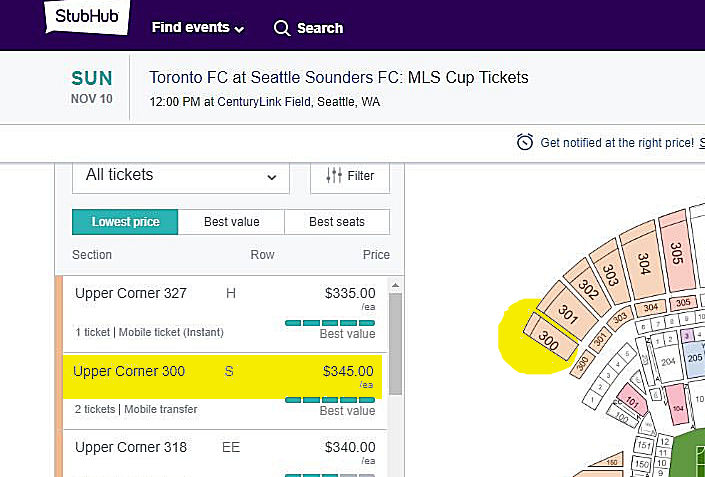






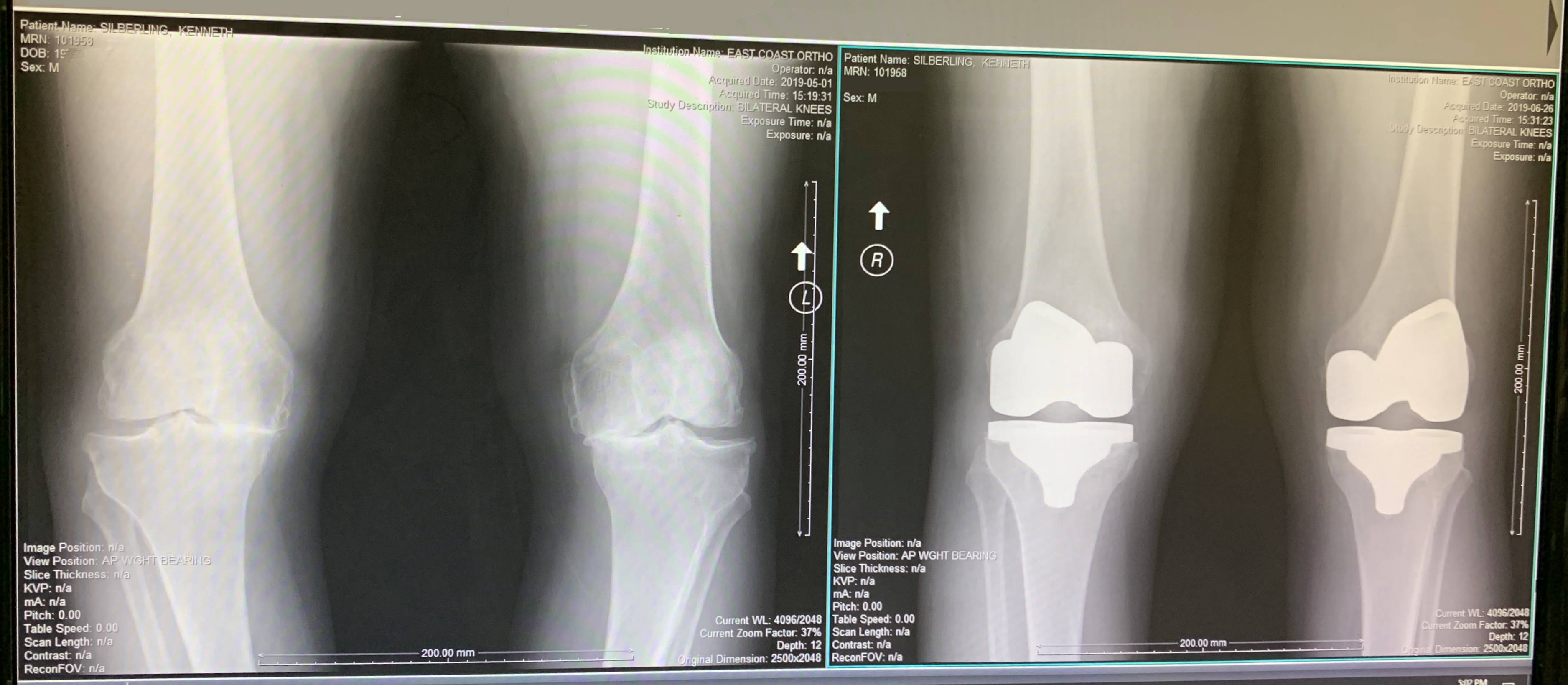

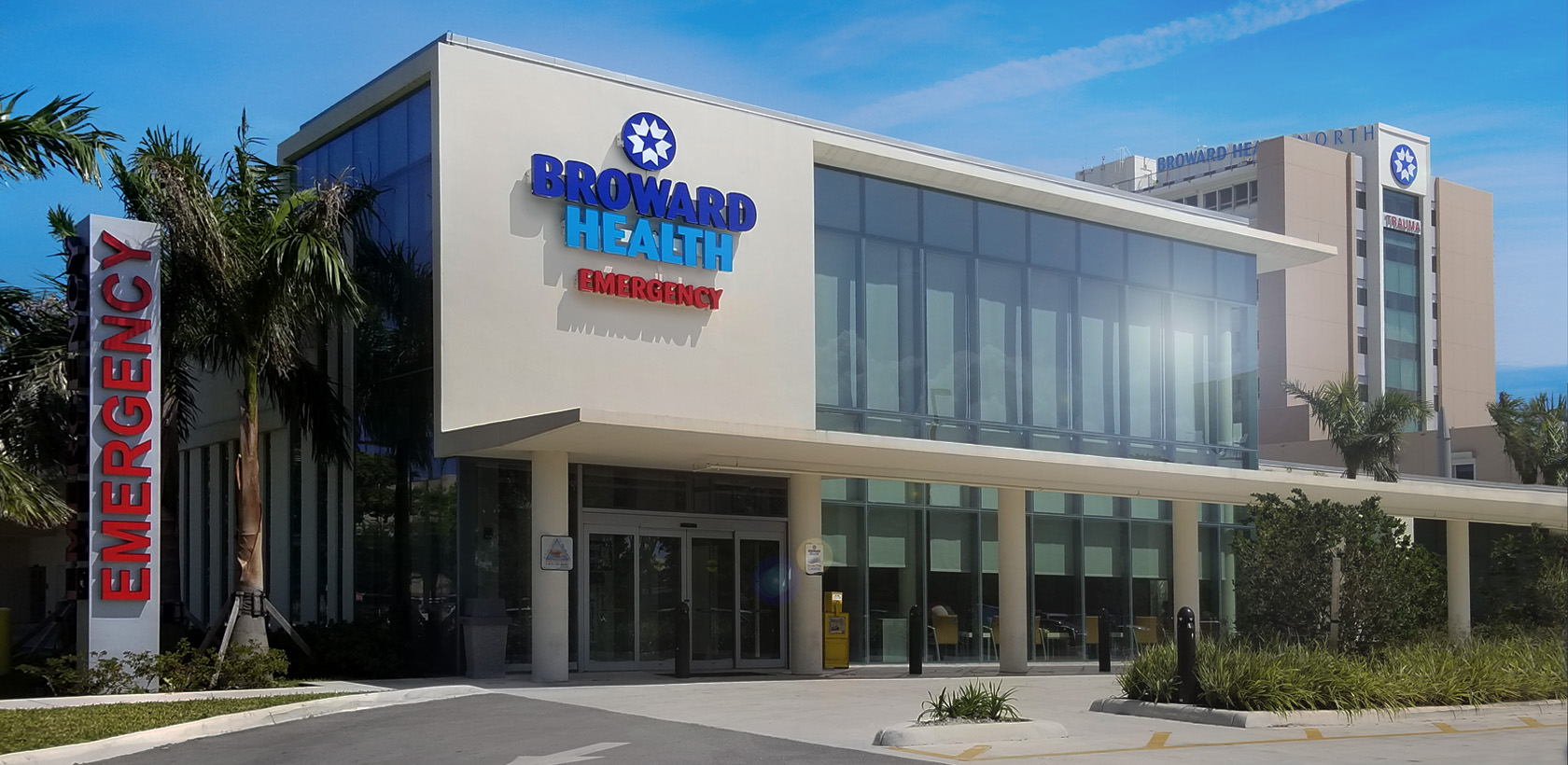

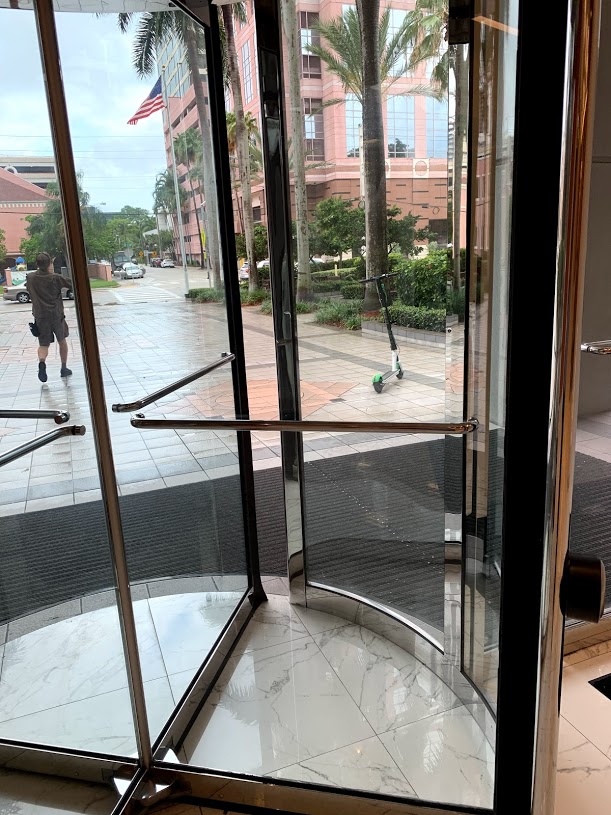

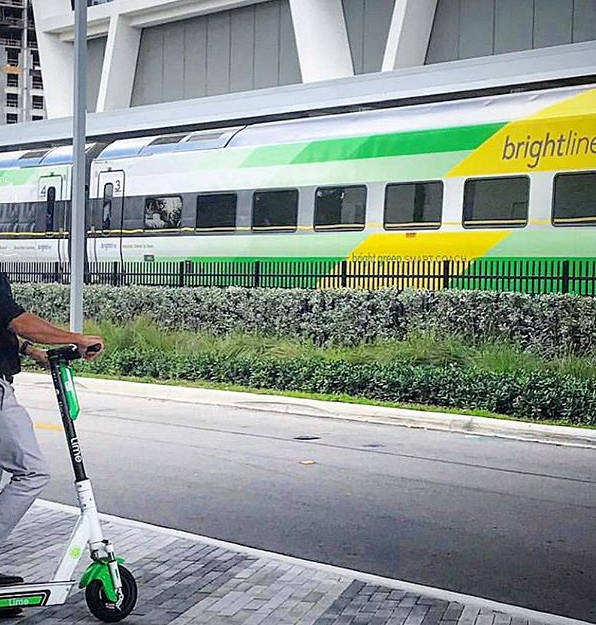
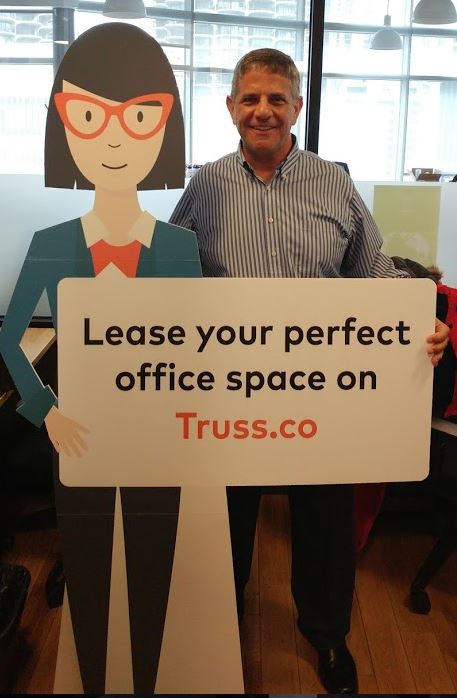
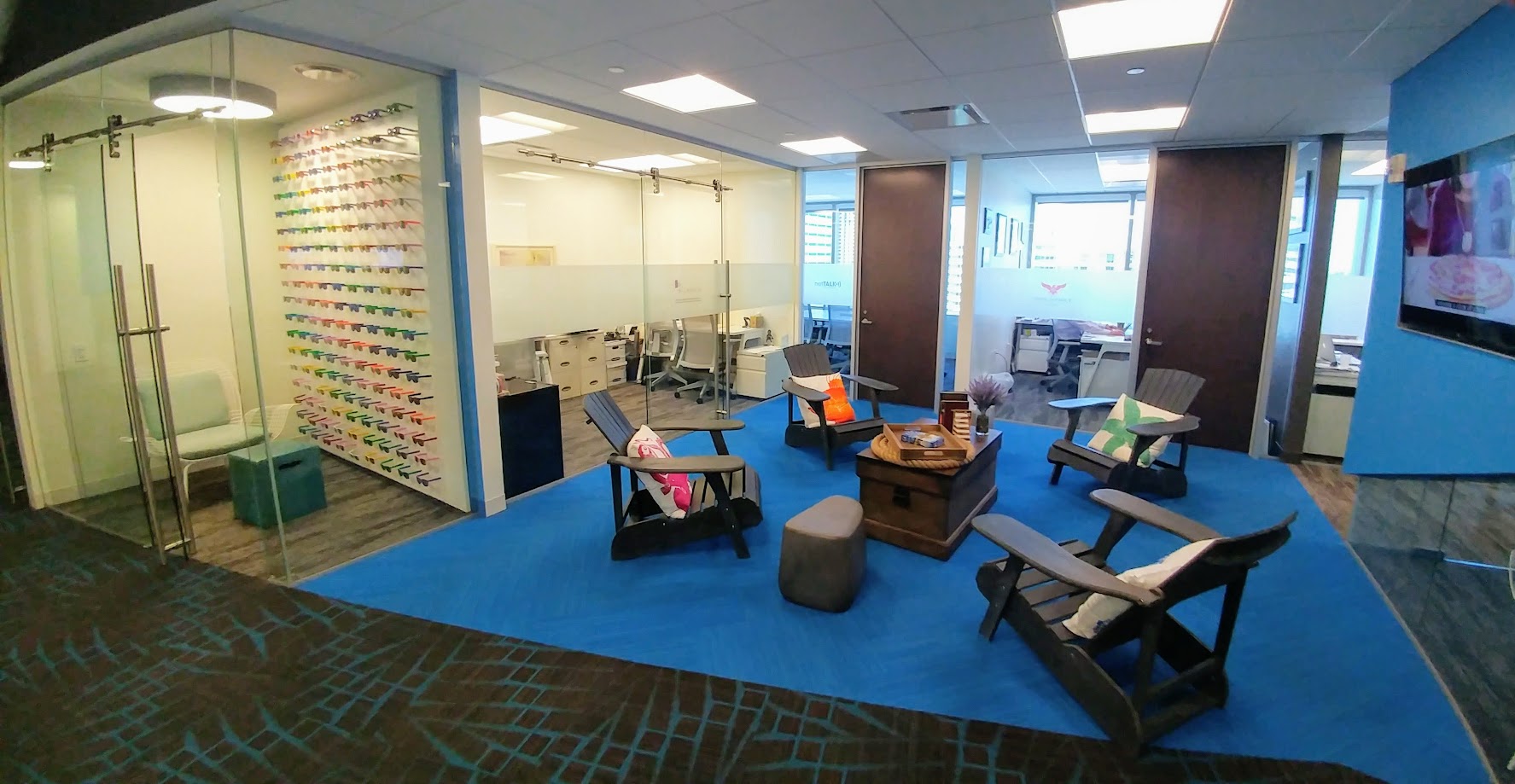
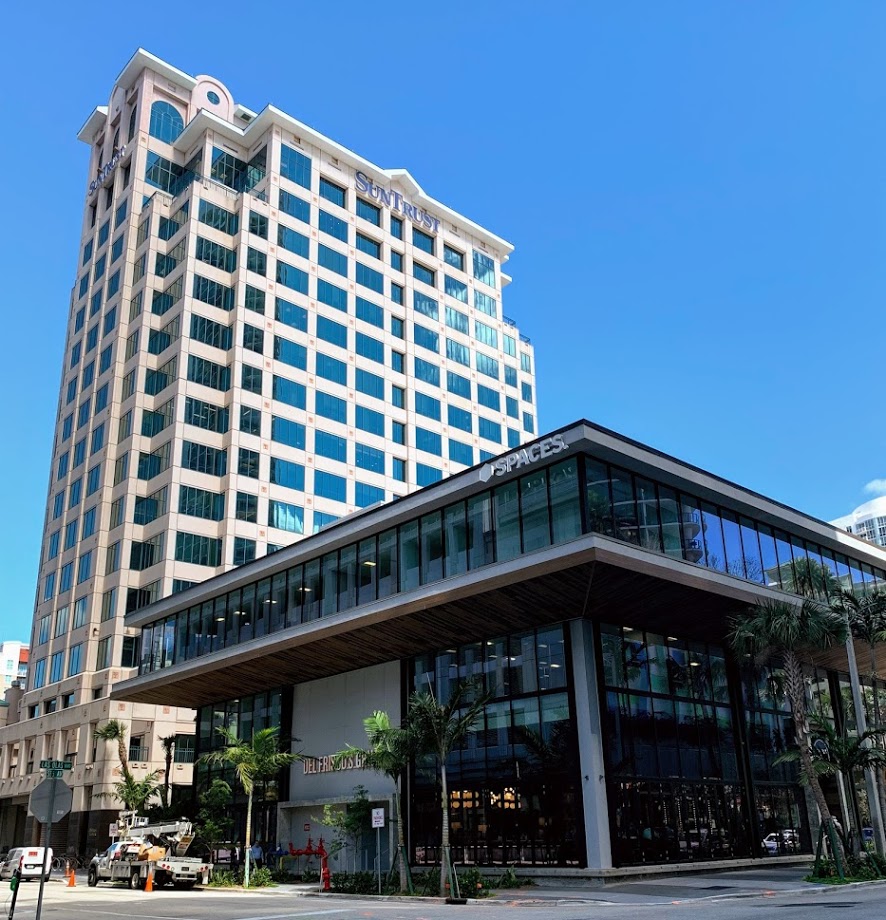
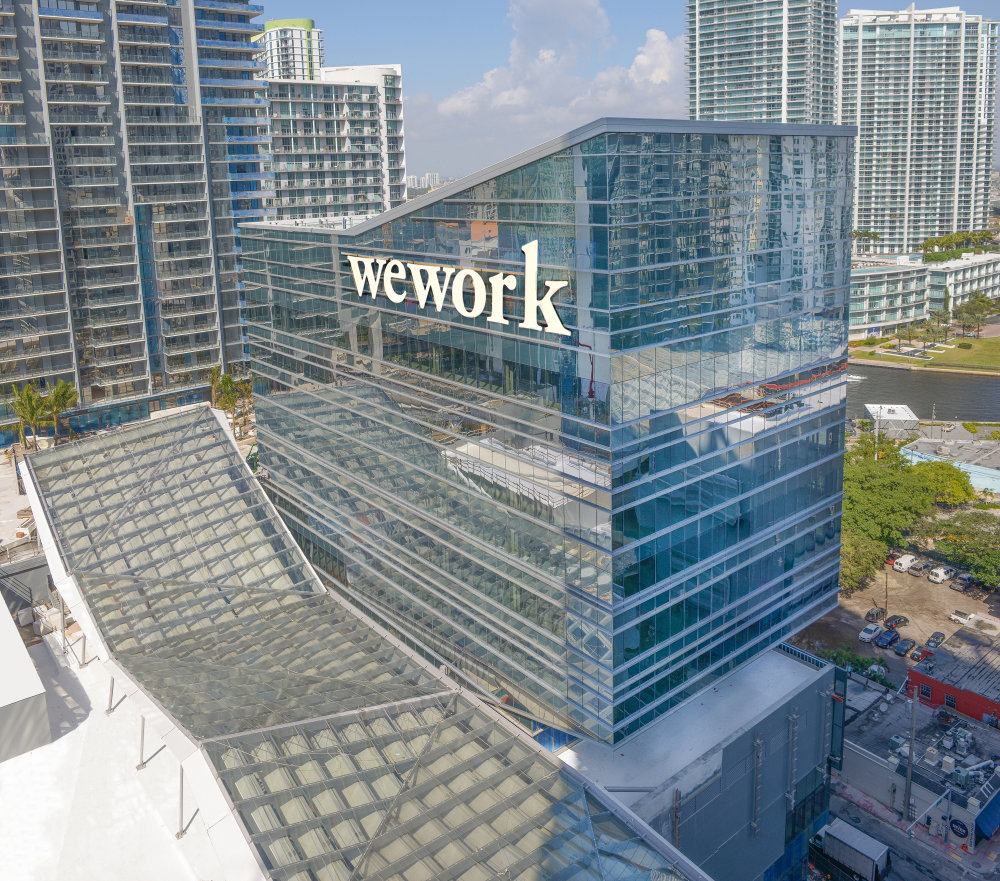













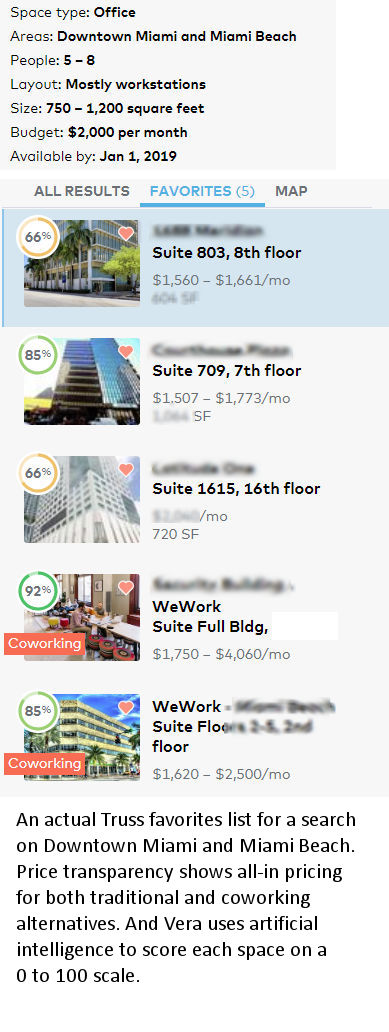


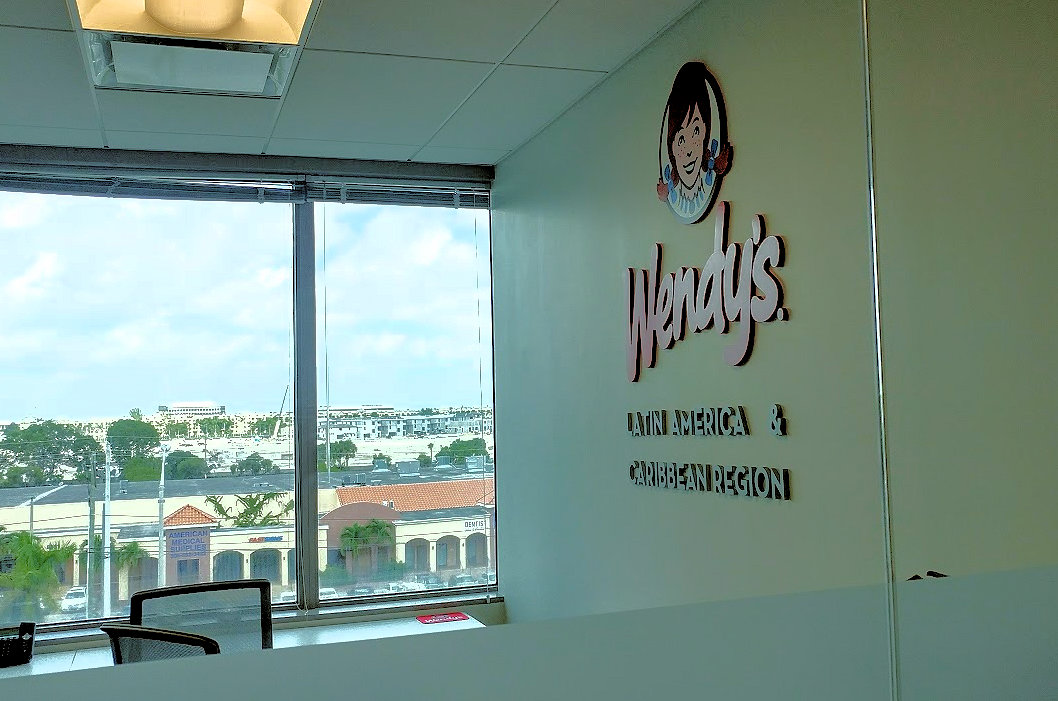


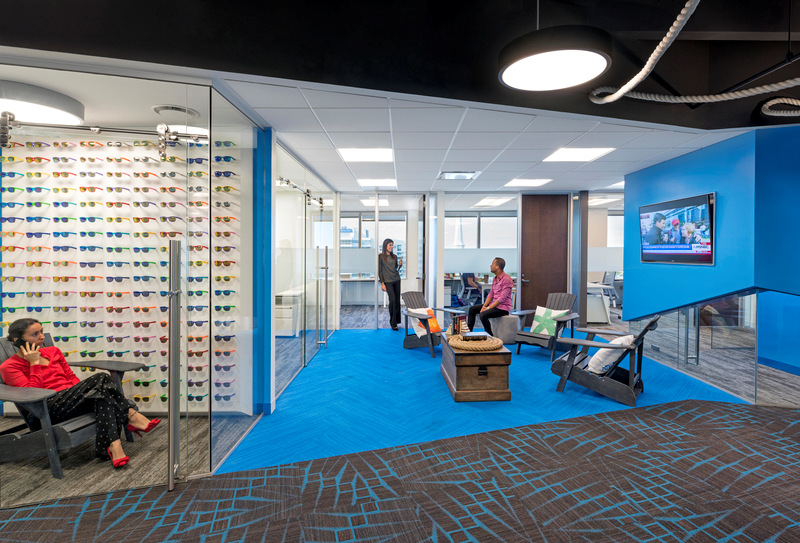


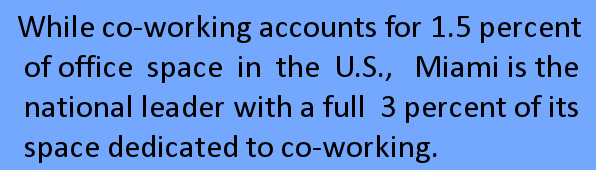
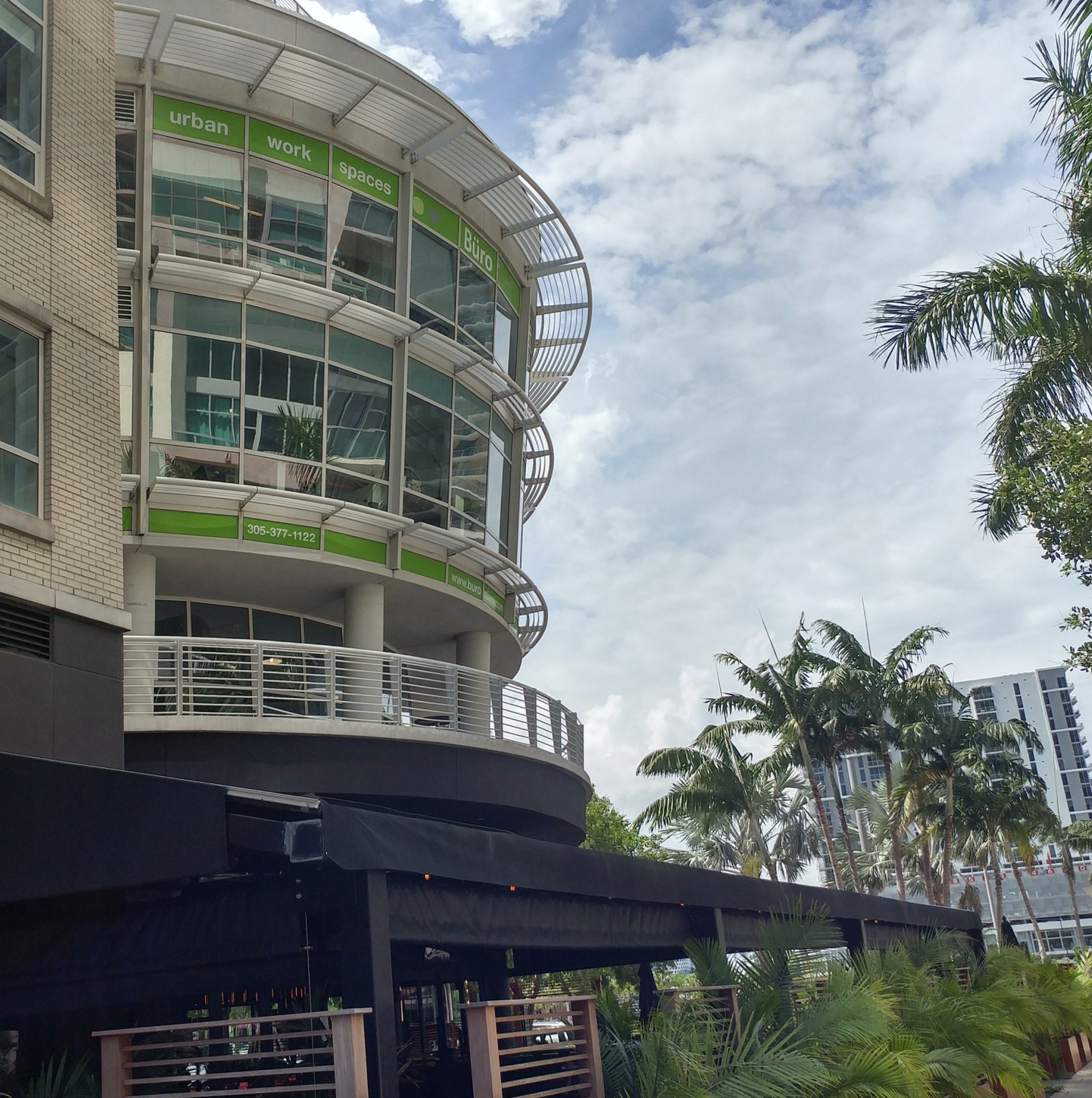
 for their ideal space with the help of artificial intelligence and virtual reality. As Truss’ Regional Senior Vice President for South Florida, I work with the tenants to turn those searches into tours, to turn the tours into leases and help companies operate more efficiently because Truss has helped them find their perfect space. Truss specializes in small to medium sized businesses – anything from a coworking space to 10,000 square feet